When we walk into a print operation for the first time, we rarely find a company short of software. We find a web shop, an MIS, a preflight tool, an imposition tool, a RIP, maybe a workflow server, and a production team working hard in the gaps between them.
The tools are there. What is missing is the connection.

Old and new, bolted together. Most stacks look like this from the inside.
The gaps are where the hours go
An order comes in through the web shop and gets keyed into the MIS. The file gets downloaded, opened, checked and fixed by hand. Someone moves it to a hot folder. Someone else checks the press queue to see if it arrived. Every system works. The operation still runs on people carrying information from one screen to the next.
That is not a technology problem. It is a connection problem, and it is the most common thing we see in nineteen years of doing this work.
| Disconnected: people carry the job | Connected: the job carries itself |
|---|---|
| Order typed into the web shop | Order entered once, by the customer |
| Retyped into the MIS | MIS job created from the order data |
| File downloaded, opened and fixed by hand | File preflighted on arrival, only exceptions reach a person |
| Moved to a hot folder by someone who remembered | Routed to the right queue automatically |
| Press queue checked by walking over | Status visible to everyone, live |
The same order, two ways. Every row on the left is a touch someone pays for.
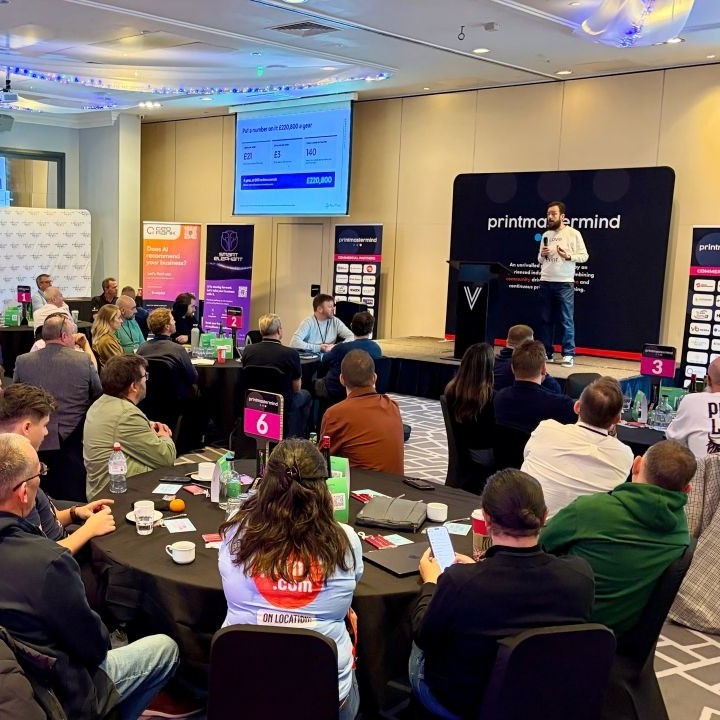
Last week I asked a room of printers at the Print Mastermind AI Summit in Blackpool which one thing they would fix first. MIS integration came out on top: 11 of the 32 people who answered picked it. Getting the order into the MIS once, complete, and never retyping it. The full results are here.
Three questions before you buy the next system
| 1 | Where does a job wait? Not where you think it waits. Watch one real job move from order to press. The bottleneck is usually somewhere nobody has looked, often in the handover between two systems that each work fine on their own. |

The knot is rarely in one system. It is in the handovers between them.
| 2 | Where does someone retype something? Every time a person keys the same order into a second system, you pay twice: once in time, once in the errors that come with it. An order should be entered once and reused everywhere. |
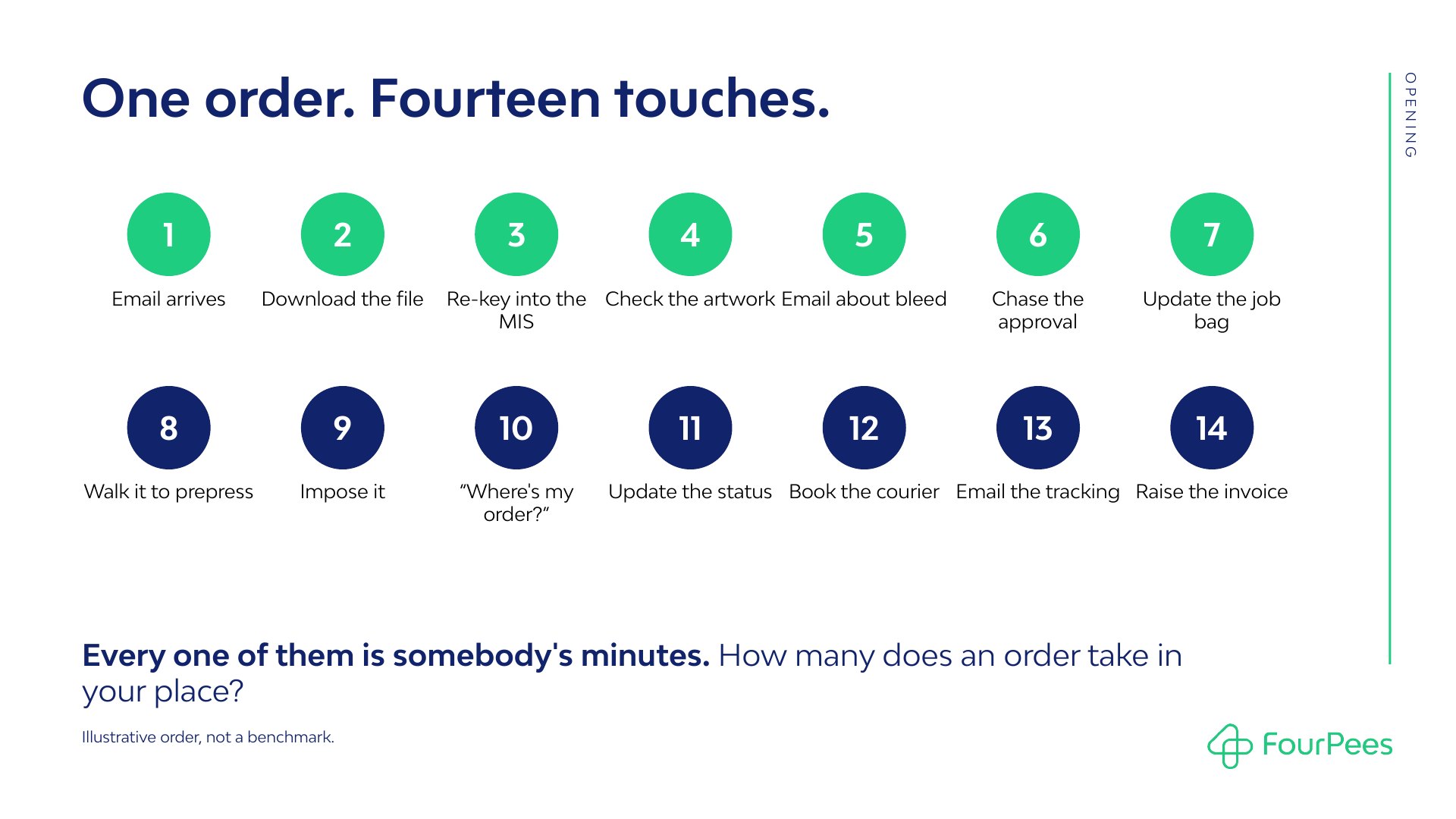
From the Blackpool talk: one order, fourteen touches.
| 3 | What did you buy that nobody uses? Most shops we meet have features, modules and whole tools that were part of a purchase and never switched on. Some are worth building on. Some are holding you back. Knowing which is which is worth more than the next licence. |
What connecting actually looks like
Connecting does not mean replacing. It means the systems you already run pass the job along without a person in the middle. In practice that is a handful of very ordinary things done well: the order arrives once, with everything production needs; the file is checked the moment it lands, and only the exceptions reach a person; the job moves to the right queue on its own; and anyone can see where it is without walking the floor.
We build those connections on open standards such as JDF, XJDF, JMF and REST, so they keep working when you change a vendor. We are multi-vendor by design, so we are not here to sell you a different stack. We start from what you already run and only add something new when the answer calls for it.

The same parts, in order. That is most of what connecting is.
A real example
Intervlag makes flags for resellers. Files used to arrive by email and every proof was built by hand, with "minutes or even hours" between upload and proof. Today an upload portal on their website checks each file automatically, shows a proof with the finishing included, and creates the production file without anyone touching it. "Within 20 seconds they have a proof," says Michael van den Bos. Nothing about it was exotic technology. It was connecting the steps that were already there. Read the Intervlag story.
Put a number on it
The cost of a disconnected stack hides in small pieces: two minutes here, five there, a reprint every week. Add them up and it is rarely small.
touches per order × minutes per touch × hourly cost × orders per week × working weeks per year
Then add what errors and reprints cost you.
And the biggest cost does not show in that number at all. If every new order needs a person, your growth is capped by headcount, not by demand.
Where to start
The result of all this is not a new system. It is the systems you have, finally working as one flow. If you want to know where your own flow stops, two places to start:
Take the Scorecard Book a meeting Leave us a message
The Scorecard is twelve questions and takes about three minutes. A Flow Check is a free 30-minute call with Andy Banks or me, where we look at where your orders stop and wait and agree the first flow worth connecting.
Tom Peire, CEO, Four Pees