CoPrA
Le centre de contrôle pour la création des profils couleur
CoPrA est le centre de contrôle pour toutes les tâches de caractérisation et génère des profils de haute qualité en quelques clics, à l’aide d’outils simples et pratiques.
CoPrA est le centre de commande parfait pour toutes les tâches de caractérisation puisqu’il permet de générer des profils de haute qualité en quelques clics, à l’aide d’outils simples et pratiques. CoPrA crée aisément des profils ICC d’imprimante, DeviceLink et SaveInk avec options multichromes adaptés aux enjeux quotidiens de la gestion des couleurs.
En quelques clics, les utilisateurs peuvent créer des profils pour les espaces gris, RVB, CMJ, CMJN ou multichromes. En amont de la caractérisation, CoPrA, qui gère l’ensemble des systèmes de profils ICC du système, se charge également de la gestion et de l’analyse des profils. Il compare aussi les courbes et les gamuts des profils avec les données ou d’autres profils ICC. Une analyse poussée aboutit à des recommandations optimales en vue d’optimiser la création des profils couleur, tandis qu’une évaluation rapide se traduit par des recommandations détaillées et une mise en œuvre absolument parfaite.
Doté d’une interface conviviale, CoPrA est actuellement considéré par ses utilisateurs du monde entier comme l’un des outils de caractérisation les plus pratiques, les plus intelligents et les plus perfectionnés du secteur. Sa technologie conforme ICC, qui offre une grande souplesse d’adaptation et de personnalisation, lui permet de suivre l’évolution constante des besoins en matière de profils et en fait le partenaire idéal pour la création de profils couleur.
CoPrA est un produit de ColorLogic proposé sous une forme évolutive allant des versions Basic et M à XXL pour répondre aux besoins de ses utilisateurs. Toutes ses versions, qui se distinguent par leur souplesse, sont personnalisables, et il est possible d’y ajouter des fonctionnalités avancées si nécessaire. Cette solution s’intègre aisément dans n’importe quel environnement d’exploitation et peut être complétée par d’autres solutions proposées par ColorLogic. C’est ainsi que le logiciel de ColorLogic offre toujours la souplesse nécessaire pour suivre l’évolution constante des besoins en matière de caractérisation.
| Caractéristiques | CoPrA Basic | CoPrA M | CoPrA L | CoPrA XL | CoPrA XXL |
| Conversion de fichiers | |||||
| RVB, CMJN, Gris & CMJ | x | x | x | x | x |
| Multichrome (de 2 à 15 canaux) | x | ||||
| Création de profils DeviceLink par modification | |||||
| RVB, Gris & LAB | x | x | x | ||
| CMJ & CMJN | x | x | x | ||
| Multichrome (jusqu'à 15 canaux) | x | ||||
| Création de profils DeviceLink à partir de profils ICC | |||||
| RVB & Gris | x | x | x | ||
| CMJN | x | x | x | ||
| SaveInk CMJN | x | x | |||
|
Multichrome (CMJN + jusqu'à 3 cannaux) |
x | ||||
| Reprofileur DeviceLinks (RVB/CMJN) | x | x | x | ||
| Reprofileur Multichrome DeviceLinks | x | ||||
| Recalcul DeviceLink | x | x | x | ||
| Création de profils d'imprimante | |||||
| Gris, RVB, CMJN avec paramètres prédéfinis | x | x | x | x | x |
| RVB & Gris | x | x | x | x | |
| CMJ & CMJN | x | x | x | x | |
|
Multichrome (CMJN + jusqu'à 3 cannaux supplémentaires) |
x | ||||
| Profils de reprofileur (RVB/CMJN) avec paramètres prédéfinis | x | x | x | x | x |
| Profils de r eprofileur (RVB/CMJN) | x | x | x | x | |
| Profils multichromes de reprofileur | x | ||||
| Gestionnaire de profils | |||||
| Rapport de profils au format PDF | x | x | x | x | x |
| Rapport de profils au format XML | x | x | x | ||
| Rapport de reprofilage | x | x | x | x | x |
| Reprofilage d'impression avec paramètres prédéfinis uniquement + Reprofileur avec paramètres prédéfinis uniquement + Gestionnaire de profils | Profilage d'imprimante + Reprofileur + Gestionnaire de profils + ColorAnt M | Profilage d'imprimante + Gestionnaire de profils + Rapport XML + ColorAnt M + DeviceLink + Modification + Reprofileur DeviceLink | Même fonctionnalités que le package L + SaveInk | Même fonctionnalités que le package XL + Multichrome + ColorAnt L |
- Création et mise à jour de profils d’imprimante
- Profils DeviceLink et multichromes
- Modification visuelle des profils DeviceLink
- Profils d’économie d’encre
- Gestion et analyse de profils
- Technologie conforme ICC, opérationnelle sur tout système compatible ICC
- Inclut l’outil de mesure ColorAnt
- Totalement compatible Mac et Windows
- Souplesse d’adaptation et de personnalisation pour suivre l’évolution constante des besoins en matière de caractérisation
- Proposé sous forme de versions évolutives
- Interface pratique et conviviale
Benefits
- Des profils couleur sur mesure
On se doit d’accorder aux profils couleur toute l’attention que l’on accorde à ses clients. Grâce au logiciel de ColorLogic, les utilisateurs peuvent désormais évaluer et traiter l’ensemble des données colorimétriques afin de créer des profils couleur ICC parfaits pour chaque travail. - S’adapter aux besoins de l’utilisateur en matière de logiciel
CoPrA est disponible en plusieurs versions, en fonction de la souplesse requise. Chaque utilisateur dispose donc du logiciel qu’il lui faut pour créer ses profils couleur. - Une compatibilité idéale
CoPrA est compatible avec n’importe quel système d’exploitation et il est aisé de l’associer aux autres solutions de ColorLogic pour obtenir un système opérationnel à 360°.
CoPrA, supplied by ColorLogic, is the control center for any profiling task as it produces high-quality profiles with easy-to-use tools in just a few clicks on the user-friendly interface. It is recognized by users worldwide as one of the most useful, intelligent and advanced profiling tools in the industry today.
Le centre de contrôle pour la création des profils couleur
CoPrA est votre centre de contrôle pour toutes les tâches de caractérisation puisqu’il permet de générer des profils de haute qualité en quelques clics, à l’aide d’outils pratiques regroupés dans une interface conviviale. CoPrA crée aisément des profils ICC d’imprimante, DeviceLink et SaveInk avec options multichromes adaptées aux enjeux quotidiens de la gestion de la couleur.

Des profils couleur sur mesure
On se doit d’accorder aux profils couleur toute l’attention que l’on accorde à ses clients. Grâce à CoPrA, les utilisateurs peuvent désormais évaluer et traiter l’ensemble des données colorimétriques afin de créer des profils couleur ICC parfaits pour chaque travail.
Normalisation des couleurs, caractérisation d’une imprimante, économies d’encre ou conversion de couleurs : vous obtenez systématiquement un profil adapté.
Talk to our sales team about this product.
Parlez-nousContact us to get started.
Parlez-nousVersion history
Showing the 5 most recent of 19 releases.
7
What’s new in CoPrA 7?
Main new features
- Auto rendering feature for DeviceLinks
- Additional Rendering Merge options for DeviceLinks
- New rendering method: Minimum Compression (Paper relative)
- New and updated presets for DeviceLinks including the new rendering options
- Added Recent Files feature
- Improved and extended Multicolor Mode with new Preserve Color Properties option for DeviceLinks
- Profile Manager 3D Gamut view: Shows deltaE of out-of-gamut colors to gamut surface
- Profile Manager: Improved Search and extract embedded profiles from DeviceLinks
- Support for printing with white ink on black substrates for CMY+White and CMYK+White for printer and DeviceLink profiling
- Extended Iteration for DeviceLinks with exceptions and new Save dialog
- Added 10 degrees observer for Printer Profiling with spectral data
- Extension of the profile report for Multicolor DeviceLinks
- Improved notification handler to avoid overlapping messages
- TAC editing for any 2CLR, 3CLR, etc., printer and DeviceLink profiles
Auto Rendering Feature for DeviceLinks
One of the most difficult decisions in setting up a DeviceLink profile is to decide which rendering options to choose from the large list of options in CoPrA for a given task. Therefore we have implemented a new Mode drop-down menu (in the Rendering section of the DeviceLink module) that allows you to select between three typical use cases and a Custom mode.

- Close Match: A typical use case is for achieving the closest possible match between two color spaces, e.g. to achieve a match similar to a proof but without paper simulation and avoiding washed out shadows. An example would be the reproduction of ISO coated V2 on a digital printing machine so that both prints should look the same.
- Another typical use case is a rather more colorful but still faithful rendering of a color space on a different printer. For example, a campaign prepared for ISO coated V2 but rendered on a large format inkjet printer. This use case can be further subdivided into either a paper relative rendering (e.g. without consideration of the paper tone - Automatic Paper Relative) or the consideration of the paper tone (Automatic Paper Absolute).

- If one of the three Mode options is selected, the two drop-down menus for the rendering methods are preselected with the right options, and the best fitting Merge slider setting is calculated. In addition, the Advanced Rendering Options such as Lightness and/or Chroma are calculated, too. All options are grayed out, so the user just needs to select one of the Modes.
- Custom gives full control to the user, enabling him to define all settings himself, as with CoPrA 6.
Note: The automatic works best if the target color space has a larger or similar gamut as the source profile.
Updated Profiling Settings
The profiling settings - also called presets - are a great starting point for Printer and DeviceLink profiling. This is most noticeable in the updated DeviceLink module where we have included the new automatic rendering feature. In addition, we have added presets, e.g. for Multicolor-to-Multicolor DeviceLinks, and for printer and DeviceLink profiling with white ink.
New Rendering Option Minimum Compression (Paper Relative)
In earlier versions of CoPrA we had already a Minimum Compression rendering method which has now been renamed to Minimum Compression (Paper Absolute). As the name suggests it minimally adjusts the white and black points only while the rest of the color space is treated more like an absolute colorimetric rendering. What was missing was a similar rendering method that works close to relative colorimetric - voilà the new Minimum Compression (Paper Relative).

Side note: We have removed the Dynamic Compression rendering method which was available for DeviceLink profiling only. It did not provide much of a difference to the other rendering methods Blackpoint Compensation or Standard Compression and therefore was regarded as obsolete.
Additional Rendering Merge options for DeviceLinks
Earlier versions of CoPrA already provided the option to Merge the advanced ColorLogic rendering methods, e.g. Standard Compression merged with Absolute Compression. However, until now it was not possible to merge the four standard ICC rendering methods or a ColorLogic rendering method with one of the four standard ICC rendering methods. This is now possible, giving the user more flexibility for color rendering with DeviceLinks.

Note: Merging is recommended among Relative Colorimetric, Absolute Colorimetric, Blackpoint Compensation and any ColorLogic rendering intent. However, merging between Perceptual rendering and other rendering intents is not recommended for 3rd party profiles.
Recent Files feature
With a right-click on the respective Load button or the small down arrow button of the profile chooser in the individual modules of the application, you can select the most recently added data (measurement data, created ICC profiles, images, etc.) so that you can easily re-select these data without having to search for them in various subfolders. This makes it easier to set up CoPrA, for example, if you have created a printer profile and immediately wanted to use this profile as a source or target profile in the DeviceLink module. This productivity feature will be extended to all ColorLogic applications so that data exchange will work across all the applications.

Note: While holding the CMD key and clicking an entry in the Recent Files list, the file and its position on your computer will be highlighted in a pop-up folder.
Notification handling
Similar to ZePrA (Troubleshooting) a notification handler has been added in CoPrA that allows multiple messages to be displayed. This avoids notifications from overlapping each other and moves out of sight. If more than one notification or warning is available, this is shown in the icons with the number of warnings. When clicking on the icon or the warning text, all warnings are shown.

Multicolor Mode Preserve Color Properties for DeviceLinks
Typically, users of CMYK-to-CMYK DeviceLinks apply the Black Generation feature Preserve separation in combination with Exceptions. This allows you to retain pure colors and the separation characteristics of the source. In order to provide a similar functionality for Multicolor-to-Multicolor DeviceLinks, we introduced a Multicolor Mode called Preserve Color Properties already in CoPrA 4.

However, this mode had the limitation that the source and target color spaces must have the same amount of channels and the same channel names. So far, this mode did not work if the number of channels in the source and target profiles was different, for example for 6 to 7 color DeviceLinks, or for channels that differed in hue or name. This has now changed fundamentally with CoPrA 7 as all types of Multicolor-to-Multicolor combinations can be combined while preserving the color characteristics. This enables users to ensure that, for example, their Orange channel stays Orange or Orange with Magenta combinations are retained. CoPrA will automatically map channels that are similar in hue even if the channel names or the channel order differ between source and target profiles. If single channels do not match between source and target profiles but other channels are, such as Blue and Violett when combining a CMYKOB with a CMYKOGV profile, the Orange channel will be retained but the Blue will be recalculated using Violet and using a mixture of the other primaries to match the Blue original colors.
Note: You will find a new preset under Settings called Print to Print - Preserve Color Properties that selects the appropriate Multicolor Mode and all other settings for you.
Profile Manager improvements
The Profile Manager introduces several new features.
- The search for profiles can be performed for various Profile Types in the Profile Filter section. This allows the combination of the Search for feature for file names with a selected Profile Type for better search results.
- The Gamut tab for printer profiles allows you to load sample data such as spot colors from various sources such as CXF, CGATS TXT, or ACO files and others. Select 3D and move your cursor over the color patches to highlight them and to display their name, Lab value and their deltaE to the gamut border of the profile. Note: The deltaE is only appropriate for the Absolute Colorimetric Rendering Intent and will not be shown for other rendering intents.
- While right-clicking on a DeviceLink profile, the embedded source and target ICC printer profiles can be extracted using the Install embedded profiles option (if embedded profiles are present). This is useful if you have been sent a DeviceLink profile and the required printer profiles are not available on your system.
- For Multicolor DeviceLink profiles we display the curves for both color combinations in the profile report and have added images for color rendering checks.

Printer and DeviceLink Profiles with white ink on black substrates
For color managed color prints on black substrates, such as textiles, white ink must be used first and colors must be applied on top of the white ink to obtain colorful graphics. If white inks are used for the separation, it would be beneficial to also use the back substrate for the black separation. However, profiling with white ink on black substrates was not available in CoPrA so far. Now, we introduce support for printing with White and 3 or 4 primary colors such as CMY or CMYK or any other primaries with or without Black. Our technology uses White ink for the separation. To create profiles with White, special test charts are required, which can be found in the test charts subfolder Special for the two cases CMY+White_on_Black and CMYK+White_on_Black.
How does it work?
- If measurement data are loaded in the New Printer Profile module that consists for example of CMYK and White, CoPrA recognizes it as a special case and a dialog appears asking whether CoPrA should preselect the required profiling Setting.

- Select Yes and the appropriate preset is selected.
- Once the appropriate Multicolor Mode - in this case the new CMYK+White mode - has been selected all other Color Generation controls are disabled. There is no change or manual editing intended in this section.

- The overall TAC can be reduced in the Black Point and TAC section.
- You may change the Perceptual Rendering, if required, in the General tab.
- Click Next to define the profile name and Save the ICC profile.
- Use the profile in your image editing and design application. Please be aware that the resulting ICC profile is a Multicolor profile, e.g. a 5CLR profile in case of CMYK+White and a 4CLR profile in case of CMY+White.
Observer choice for Printer Profiling
The Viewing Condition can be changed by the user in the General tab of the Printer Profiling module. The default setting for ICC profiles is D50 and 2 degrees standard observer. However, in some industries such as textile printing the viewing condition is D65 and 10 degrees standard observer. With CoPrA 7 users can change the Observer to 10 Degrees if required, provided that spectral data has been loaded for the measured test chart.
TAC editing for 2 or 3 channel profiles
For 3 color combinations such as CMY and even for 2 color combinations, there is a need to control TAC independently for color concerns such as ink bleeding on difficult materials. An automatic TAC control of a 3C profile will usually result in a higher ink load than some materials can tolerate, and 3C printing is likely to be employed in industrial printing processes such as textile, ceramics and others, where TAC must be kept low—often under 200%. Therefore, in CoPrA 7 we now introduced the ability to control the TAC for printer and DeviceLink profiles with 3 and 2 color channels.

Another improvement for 2 and 3 color DeviceLink profiles is that we can exclude channels now, too.

DeviceLink Iteration improvements
The Iteration DeviceLink module is a great feature to get the best possible match for proofing. Proofing uses absolute colorimetric rendering without color exceptions. However, in digital production printing, perceptual rendering methods and color exceptions are used to keep colors pure. Nevertheless, there might be an interest to optimize the colors by iteration measurements.
It is not always recommended to do so, especially as out-of-gamut colors cannot be optimized. In CoPrA 7 it is now possible to iterate data for production printing while retaining exceptions during iteration. It recognizes exceptions and rendering settings from the selected reference DeviceLink profile and retains them but only if the selected DeviceLink is a ColorLogic profile. A checkbox will be shown in the dialog making the user aware that there are exceptions used. By default, the checkbox is enabled but the user may disable it.

Furthermore, the layout of the iteration window now corresponds to that of the other CoPrA profiling modules. For example, the Back and Next buttons and a dedicated Save dialog have been added. Next takes the user now to the typical Save dialog where the profile Name, Size, embedding of source and target profiles and the creation of a profile report can be specified.
The Default Template for the profile naming uses an option that adds the number of iterations to each iterated DeviceLink. It is recommended to use the Auto Size option because size matters for iteration. The automation will make sure to always use the highest precision when creating the iterated DeviceLink.
CoPrA 7.0.1
Bug Fixes and Improvements in CoPrA 7.0.1
- Improved black point calculation under Black Point and TAC for printer profiles for measurement data with very light black points and colorful white points. Ticket #212478
- Update Profile: Multicolor printer profiles did not contain the correct measurement data saved in the profiles. Now, CoPrA saves the original measurement data from the update chart into the TARG profile tag. In case of a measurement data correction, the original data is stored in the TARG2 tag and the corrected data in the TARG tag as in case of new printer profiles. Ticket #202289
- Printer profiles had unnecessarily two TARG tags. Typically there is only one TARG tag for the profiling data and the second tag will be only created if either Measurement Correction or Brightener Compensation or a non default Viewing Condition has been selected. The checking of illumination and Observer settings has been improved. Ticket #212519
- The index error when loading measurement data without DCS data for printer profiling is fixed. Now an error is shown if the DCS data contains less patches than the measurement data.
Note: CoPrA uses the DCS data from the previous loaded chart. This little trick allows PCS only data (measurement data without DCS) to be loaded. - Fixes in Image Conversion
– When converting to Lab the absolute colorimetric rendering intent was not used when enabling the Paper White Simulation checkbox.
– When converting images to Lab as target color space and enabling the Use Layer functionality it did not work for multiple profiles.
– An embedded RGB profile from a loaded RGB image was not used. Now, if an image including an embedded profile is loaded, this profile will be selected as source profile. - It has been fixed that Multicolor-DeviceLink profiles using the Black Generation option Target Profile with ColorLogic Gamut Mapping were creating inferior results compared to the option Target Profile. Ticket #202212
- It has been fixed that Linearization DeviceLink profiles using the G7 Calculation Mode did use deprecated G7 definitions.
- Preliminary support for Dark Mode on modern macOS systems from 10.14 onwards.
- Fixed that CoPrA runs on modern Macs with macOS Big Sur and M1-Apple Silicon processors.
- The newest ColorAnt 7.0.2 with MeasureTool 4.0.2 has been included in the installer.
8
We are excited to announce the release of CoPrA 8, the ultimate profiling tool in any color space on Wednesday, September 29, 2021.
Main New Features in CoPrA 8
- Redesigned DeviceLink Editing module
- New channel combination feature for special Multicolor profiles
- Speed boost for profile calculation
- Improved Image Conversion
- Enhanced auto Rendering for DeviceLinks
- DeviceLink reseparation with Preserve 0% Black
- Enhanced RGB DeviceLink profiling options by additional Black Calculation modes
- Enhanced DeviceLink Iteration Profile Report
- Enhanced DeviceLink Linearization Profile Report
- New and improved DeviceLink profiling settings
- macOS support for Catalina (10.15.x), BigSur (11.x) and dark mode
Redesigned DeviceLink Editing Module
To facilitate the creation of custom DeviceLink profiles based on individually edited test charts (EditTargets) with the Editing tool, the user is now guided through the entire process.
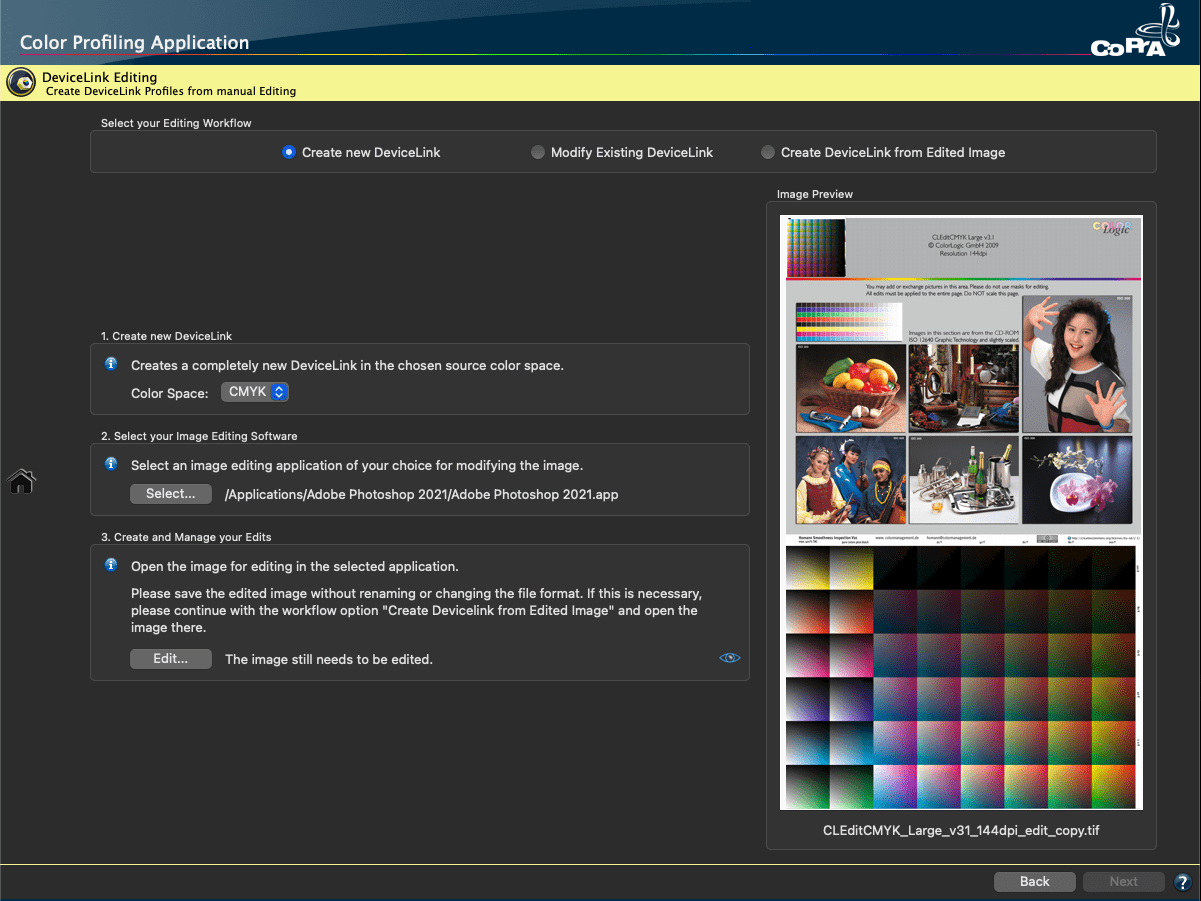
The DeviceLink Editing process now begins with the selection of one of the three newly implemented editing workflows. These workflows are used to create new DeviceLinks, modify existing DeviceLinks or to create DeviceLinks from edited images.

For the first two workflows it is no longer necessary to select the required EditTarget manually. Simply Select the editing software of your choice and click Edit. This will automatically open the appropriate EditTarget (EditTargets are provided with CoPrA for CMYK, RGB, Lab or Grayscale) in your editing software (e.g. Photoshop).
Now any desired color corrections can be applied and the edited EditTarget can be saved. CoPrA automatically recognizes the saved EditTarget.
Clicking Next takes the user to the next step, where the DeviceLink profile settings can be specified and the modifications for each color patch can be evaluated.
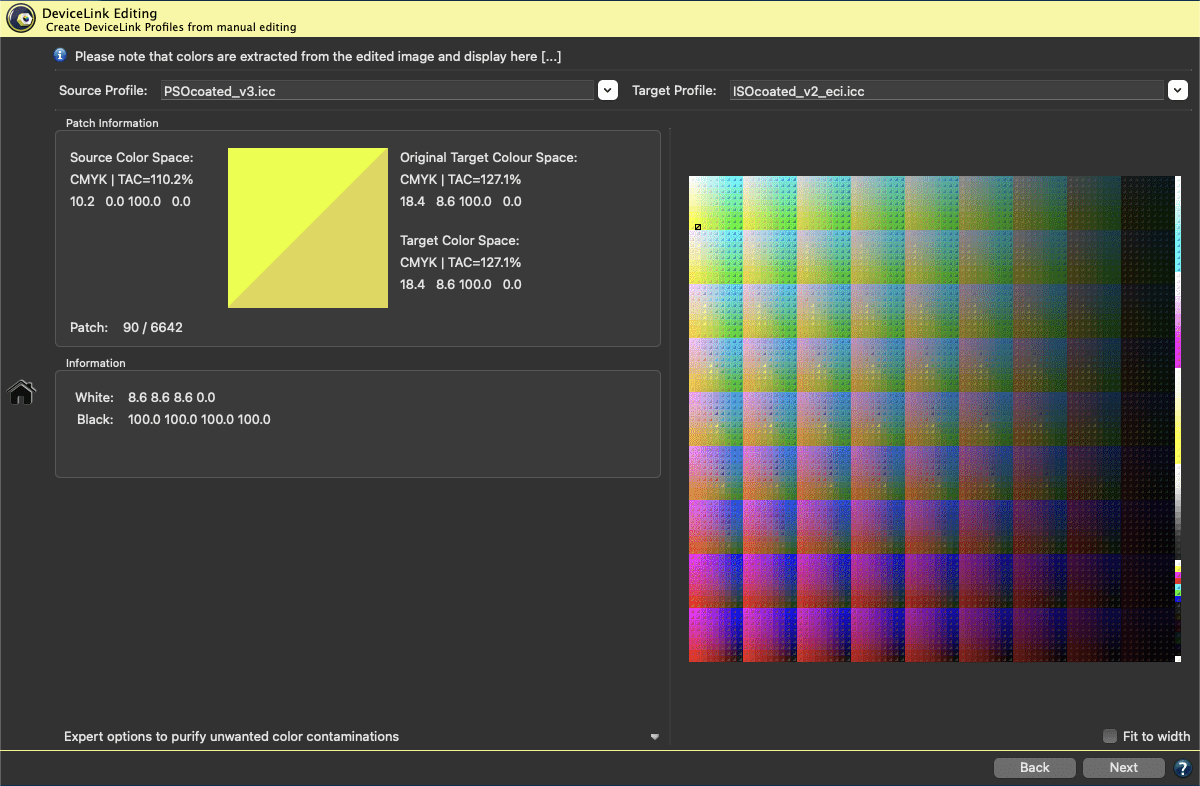
Finally, the user is guided to the profile creation dialog, where the process is completed and the custom DeviceLink is created. Thanks to the new process, DeviceLink Editing is now as straightforward as possible.
New channel combination feature for Multicolor profiles
CoPrA 8 has great new features to create printer and DeviceLink profiles for industrial applications like ceramics or textile printing with Multicolor inks. These industries often choose specialty inks for production-related reasons to increase the color gamut in the shadows and some colored areas.
In CoPrA 8, the two Multicolor Modes for special inks present in previous versions have been removed. Instead, an intelligent automatic function recognizes whether the additional inks are typical gamut-extending colors or rather special inks and uses them accordingly. This significantly simplifies Multicolor profiling for these industrial applications.
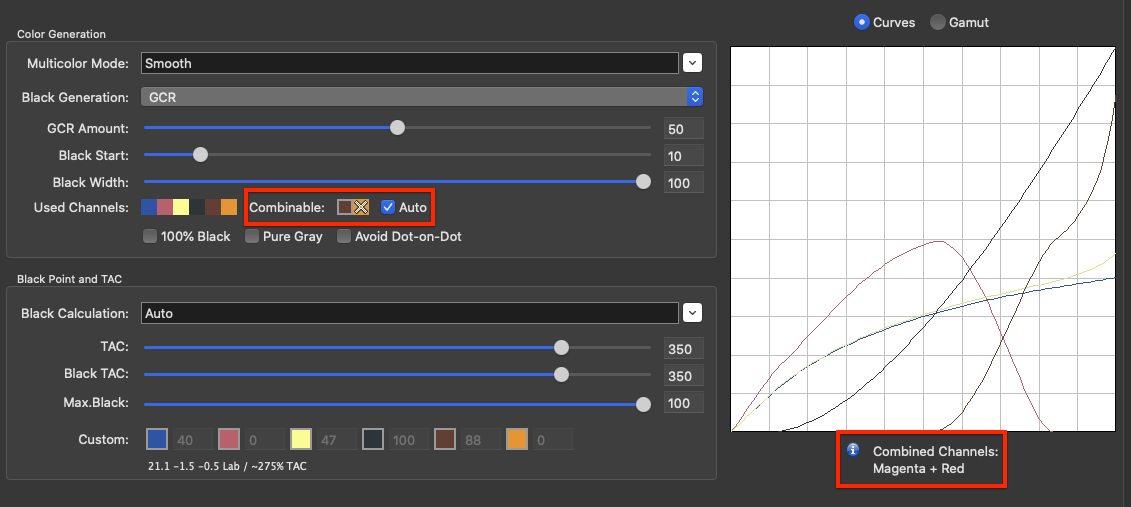
A new Combinable option has been added next to the Used Channels section. The new Auto checkbox is enabled by default on all Multicolor presets and specifies the channels that can be combined to extend the gamut. The channels that can be combined are displayed below the preview for Curves and Gamut. In the Gamut preview CoPrA shows the impact of the combined colors by the gamut volume number. If the Auto checkbox is enabled CoPrA automatically calculates and selects the ink combinations with the largest gamut and indicates the combined channels.
If the Auto checkbox is disabled, the channels can be defined manually. Click on the combinable channels to enable or disable them. If you do not want to combine the additional inks with the 4 standard inks, you can disable the channels of the additional inks. Disabled channels are marked with an X.
Speed Boost for Profile Calculation
Profile calculation has been accelerated due to improved profiling technology.
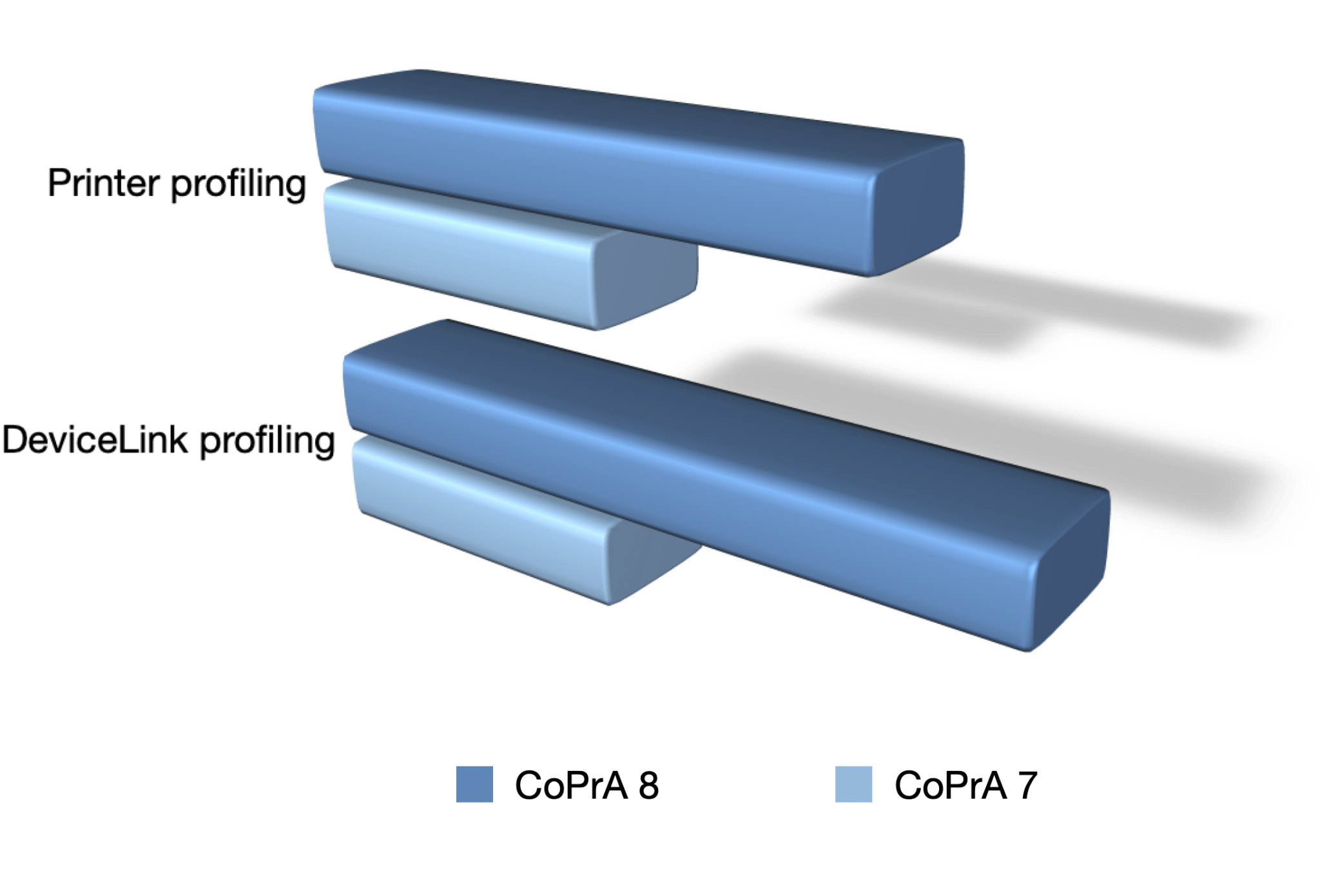
Printer profiles are now calculated up to 1.8 times faster on average than in CoPrA 7.
DeviceLink profiles are now calculated up to 2.2 times faster on average than in CoPrA 7.
Improved Image Conversion
The improved Image Conversion now uses an adjustable overlay tool to define the comparison area. The comparison area allows you to compare the image file using the source profile and the selected rendering intent with the conversion to the target profile. This way, the effects of the defined color management workflow can be compared to the original source image.
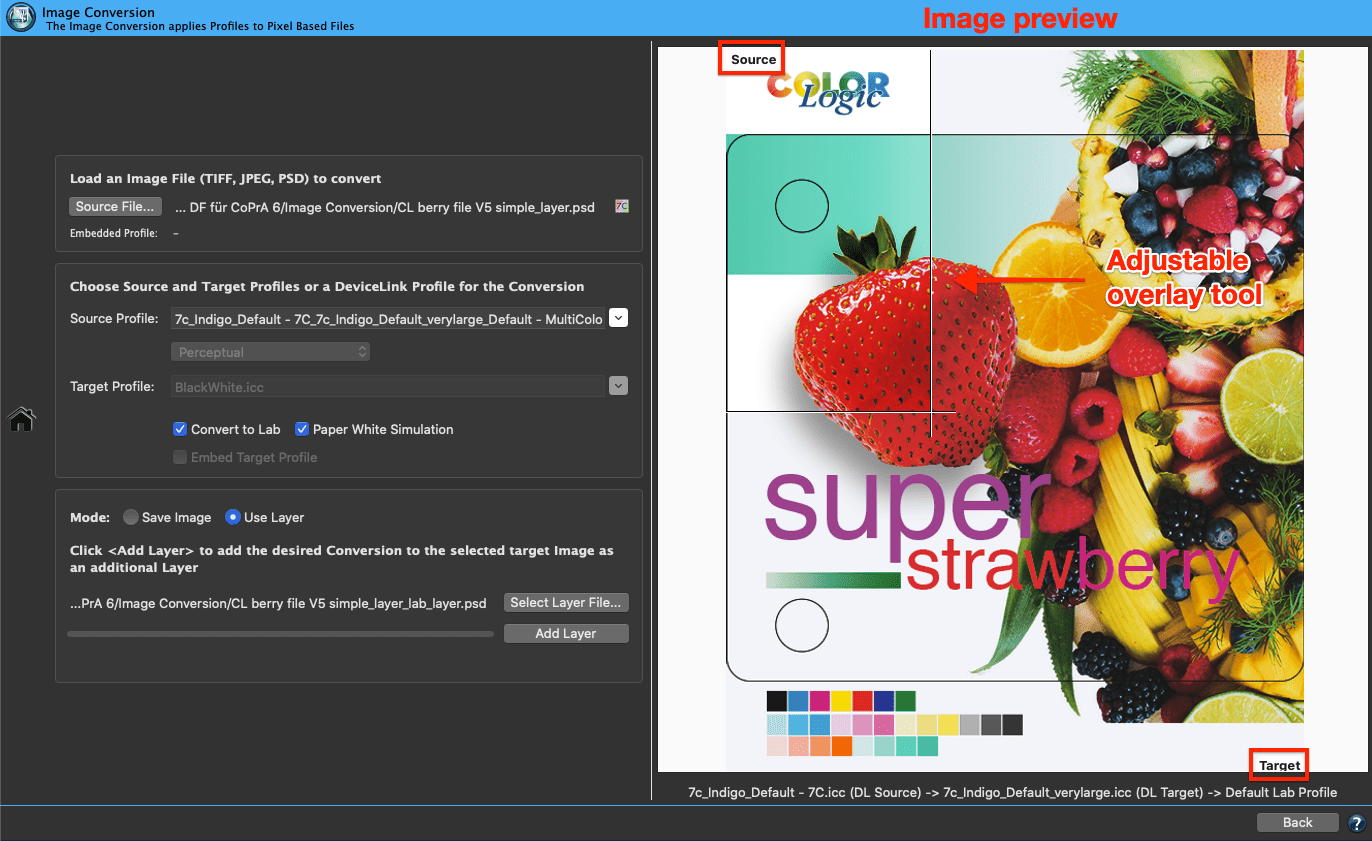
The preview of the target image is shown in the preview panel on the right. The adjustable overlay tool allows to define the visible area from the source to the target image by resizing it. This is done by moving the lines up/down or left/right while holding down the left mouse button.
The image preview uses either the embedded profile of the loaded image or – if there is no embedded profile – the specified Source Profile to convert the image colors to the Target Profile via the selected rendering intent. The complete color management workflow will be applied to the display profile. Therefore, if the monitor is calibrated the image is shown in true colors.
The Paper White Simulation can be used as a soft-proof for the defined color management workflow. If activated, the complete profile settings and rendering intents will be simulated on the screen under Target.
In addition, when the Convert to Lab checkbox is enabled, the Paper White Simulation checkbox can also be activated. If activated, the conversion to Lab uses the absolute colorimetric rendering intent, if disabled, it uses the relative colorimetric rendering intent.
Add Layer: To test various profiles, the same original image can be converted again with different profiles, and the resulting files can be stacked as layers in a single file. Such a PSD file allows users to switch between the layers in Photoshop to evaluate the quality of the conversions.
For a better identification of the tested profiles, the layer names contain the profile names and the rendering intents.

Enhanced Auto Rendering for DeviceLinks
The Rendering modes Automatic Paper Relative and Automatic Paper Absolute automatically calculate the best of two rendering methods including Merge, Lightness and Chroma adjustments.
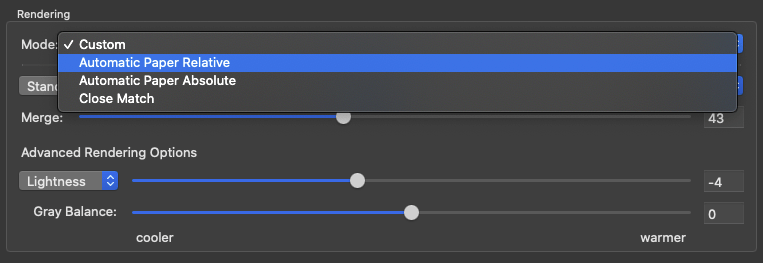
These rendering modes have been improved by now supporting different gamut sizes, e.g. small to large gamuts, large to small gamuts and similar sized gamuts, so that high quality DeviceLinks can be created with ease.
DeviceLink Reseparation with Preserve 0% Black
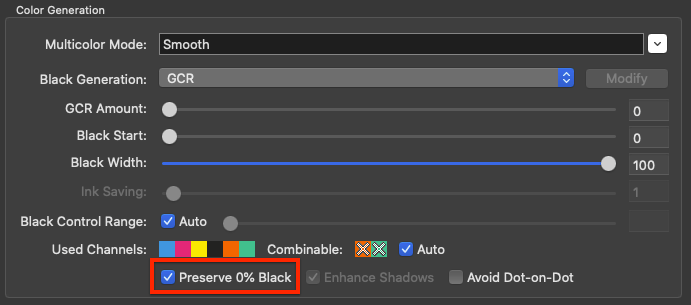
The Preserve 0% Black option is now available for the Black Generation modes Target Profile with ColorLogic Gamut Mapping, GCR, UCR, Preserve Separation or Save Ink. It prevents the generation of black in separations for source colors without black.
Note: Previously it was only available for the mode Preserve Separations.
Enhanced RGB DeviceLink profiling options by additional Black Calculation modes
For DeviceLink profiling with an RGB target profile, the Color Generation mode can now be defined. There are two options available: Target Profile and Target Profile with ColorLogic Gamut Mapping.
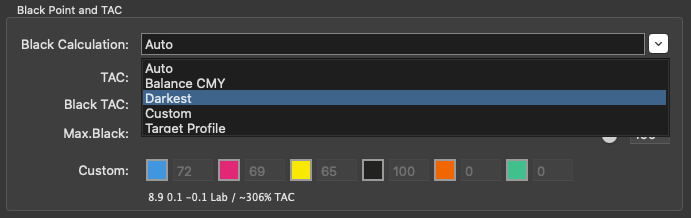
The mode Target Profile achieves the same results as a normal ICC conversion.
Target Profile with ColorLogic Gamut Mapping is using the following new Black Calculation modes: Auto, Neutral, Darkest, Custom and Target Profile.
Enhanced DeviceLink Iteration Profile Report
The report has been expanded to include the evaluation results and details of the DeviceLink iteration.
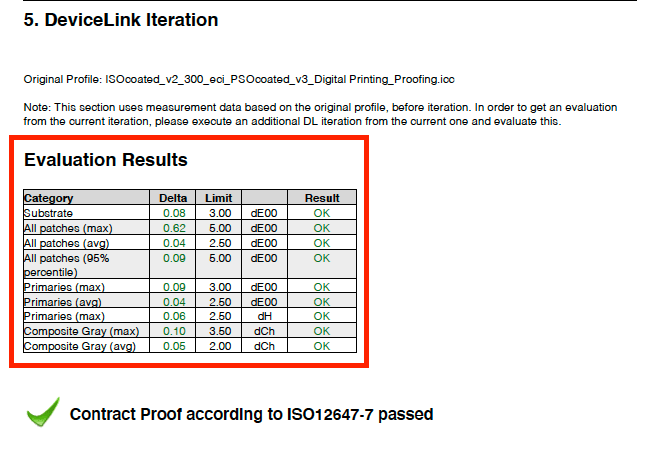
Enhanced DeviceLink Linearization Profile Report
The report has been extended and now shows curves and graphics that take into account the different calculation modes of the Linearization options which are dynamically included in the report.
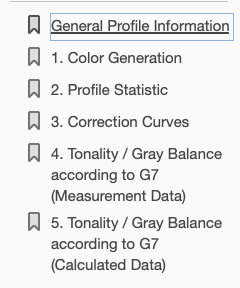
When creating a linearization according to G7, the report shows the tonality/gray balance and the different NPDC curves before and after the calculation. The same applies to the various linearity curves such as ColorLogic Default (Colorimetric Linearization) or according to ISO20654.
New and improved DeviceLink Profiling Settings
To further simplify DeviceLink creation, new DeviceLink profiling settings have been provided for various color mode combinations. In addition, some previous Default and other settings have been improved.
macOS support for Catalina (10.15.x), BigSur (11.x) and Dark Mode
CoPrA 8 fully supports macOS Catalina and Big Sur as well as the Dark Mode.
8.0.1.
Bug Fixes and Improvements in CoPrA 8.0.1
General:
- Improved color managed preview on primary and secondary screens on macOS.
- Displays using a vertical resolution of 900 px now show the bottom bar with version information (registration window) and profiling progress.
- Defect profiles in ColorSync/Profiles folder do not cause software crashes on Apple M1 chip systems.
- The latest ColorAnt version 8.0.2 with Measure Tool 5.0.1 is included.
Printer Profiling:
- Updated preset “Default – Multicolor” for Multicolor printer profiles from 4CLR up to 12CLR.
- New preset “Enhanced Saturation” for Multicolor printer profiles from 4CLR up to 12CLR.
- Multicolor Presets imported from older versions (e.g. Strong with Special Inks) are now used correctly.
- Measure: The Konica Minolta FD-9 can now be used on Apple M1 chip systems. (Ticket: #222969)
DeviceLink Profiling:
- The Multicolor Mode “Strong” of the target profile is now saved in the DeviceLink profile.
- The Multicolor Mode “Use Settings of the Target Profile” now shows correct Multicolor mode Smooth or Strong.
- When settings are changed, the gamut plot in the Rendering tab is updated accordingly after the new values are calculated. (Ticket #222988)
- The DeviceLink TAC is not exceeded for MaxRGB and MaxCMY exceptions. (Ticket #223036)
DeviceLink Editing:
- Spot color channels in „Create DeviceLink from edited Image” are now displayed correctly in the Image Preview.
Image Conversion:
- Specific files are now processed correctly without alert message: Dimension Mismatch. (Ticket: #222938)
Help menu:
- A link to the Tutorials/Sample Data section on the ColorLogic webpage in now available.
9
Main New Features in CoPrA 9
- Redesigned Update Profile tool
- Calculate Multicolor Profile Variants
- Improved reactivation of the Black channel
- Improved preview of reference data when using White Ink
- Gamut preview for DeviceLink profiles in the Profile Manager
- New 3D gamut view scaling method
- New context menu offers several more gamut view options
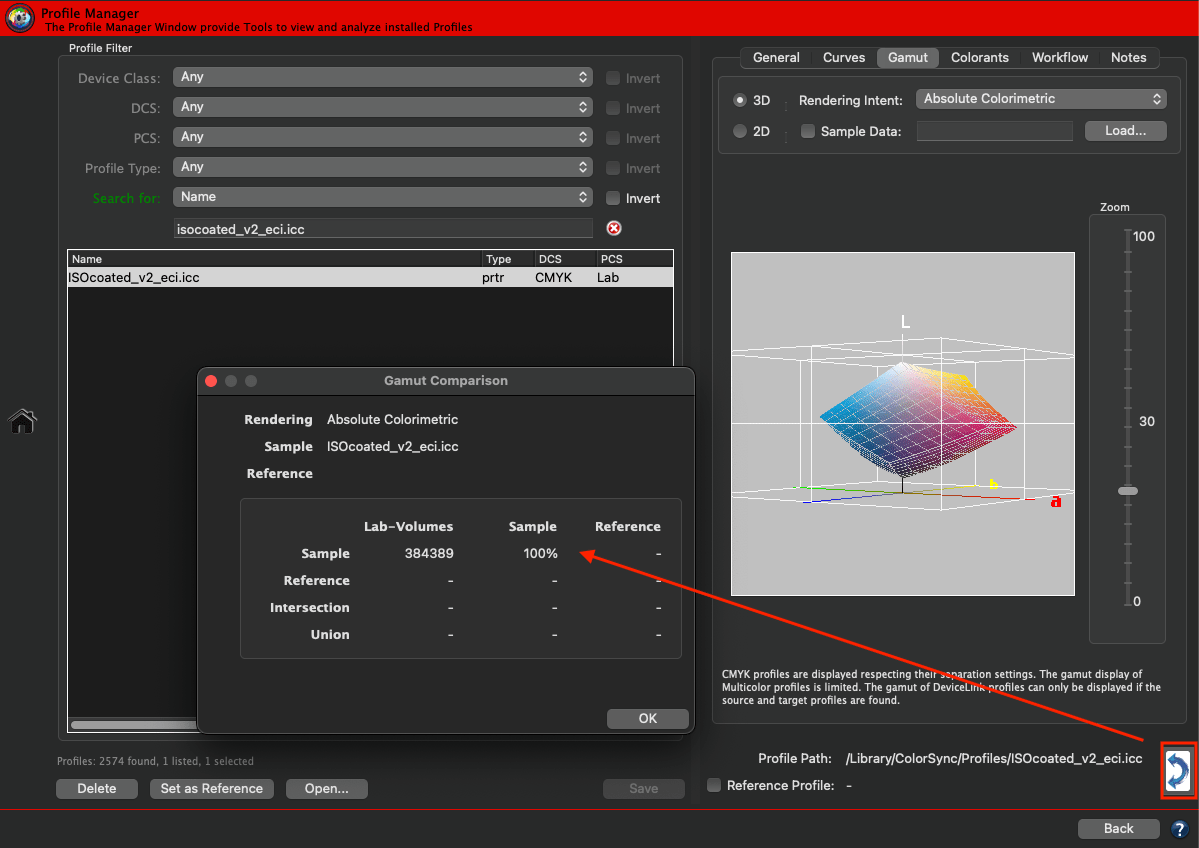
- Calculation of the profile gamut size in Gamut Comparison without Reference profile
DeviceLink Linearization
- New InkSplitting Calculation Mode in the Linearization tool combines light and full ink channels
- Improved preview of reference data when using White Ink
- Improved perceptual rendering Absolute Compression for colorful substrates or substrates with high OBAs
- New softproof option Black Ink Simulation
- InkSave value is now shown when using the Use Layer mode
macOS Support
- Profile calculation speed boost due to native Apple M1 chip support
- macOS support for Catalina (10.15.x), BigSur (11.x), Monterey (12.x) and dark mode
Improvements and bug fixes
Update Profile
Redesigned Update Profile tool
The Update Profile tool has been revised to provide a clearer and more efficient workflow. As a result, the workflow has been simplified and optimized, and some new handy reports have been added.
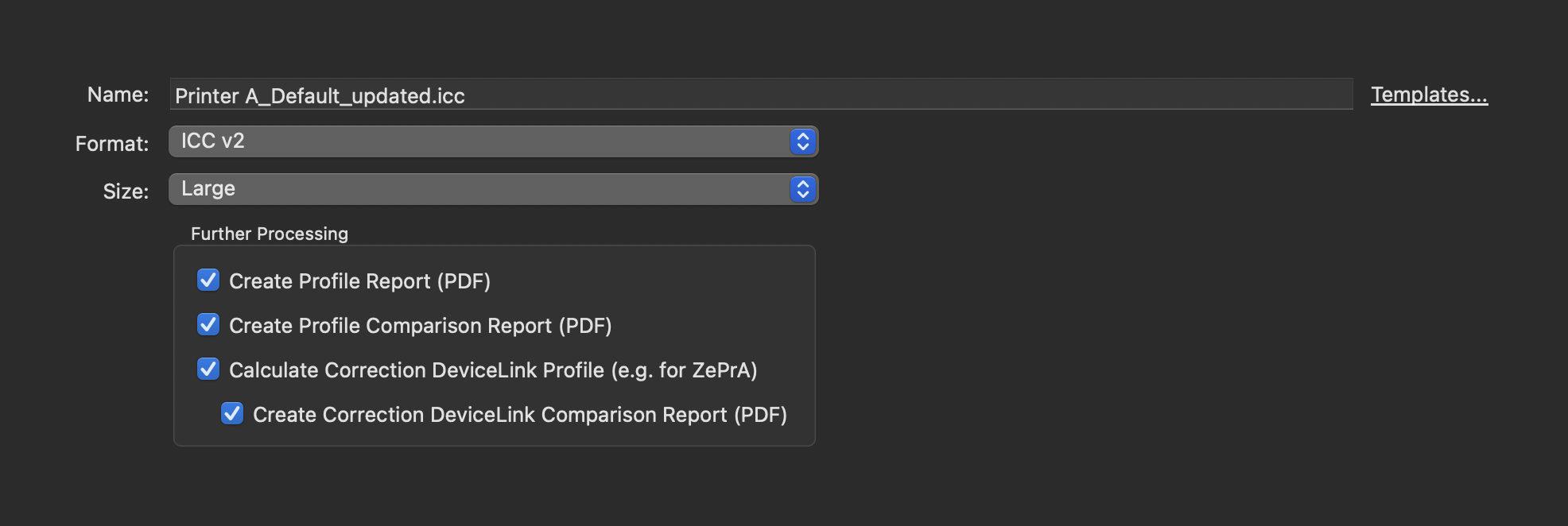
A Profile Comparison Report can be created in addition to or as an alternative to a Profile Report. It provides information about the extent to which the printer profile and the updated profile reflect the measurement data and the improvements that can be achieved using the updated profile.
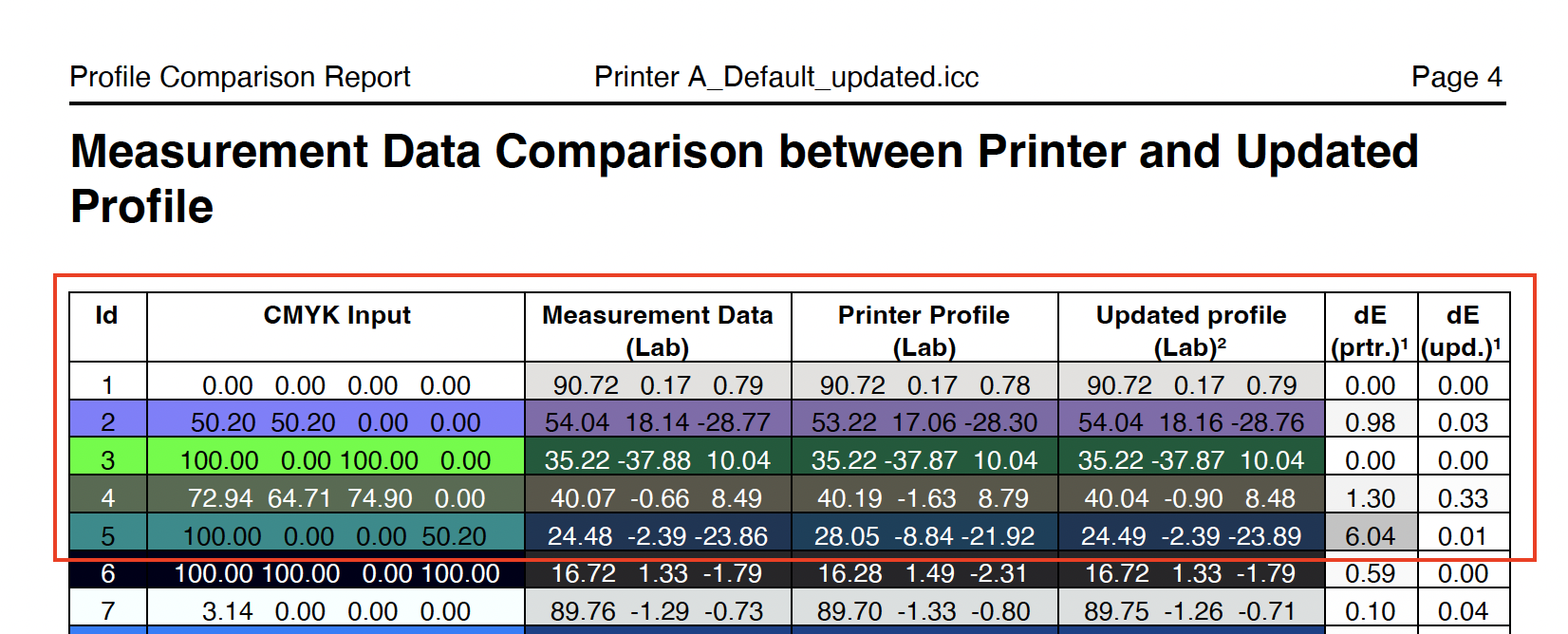
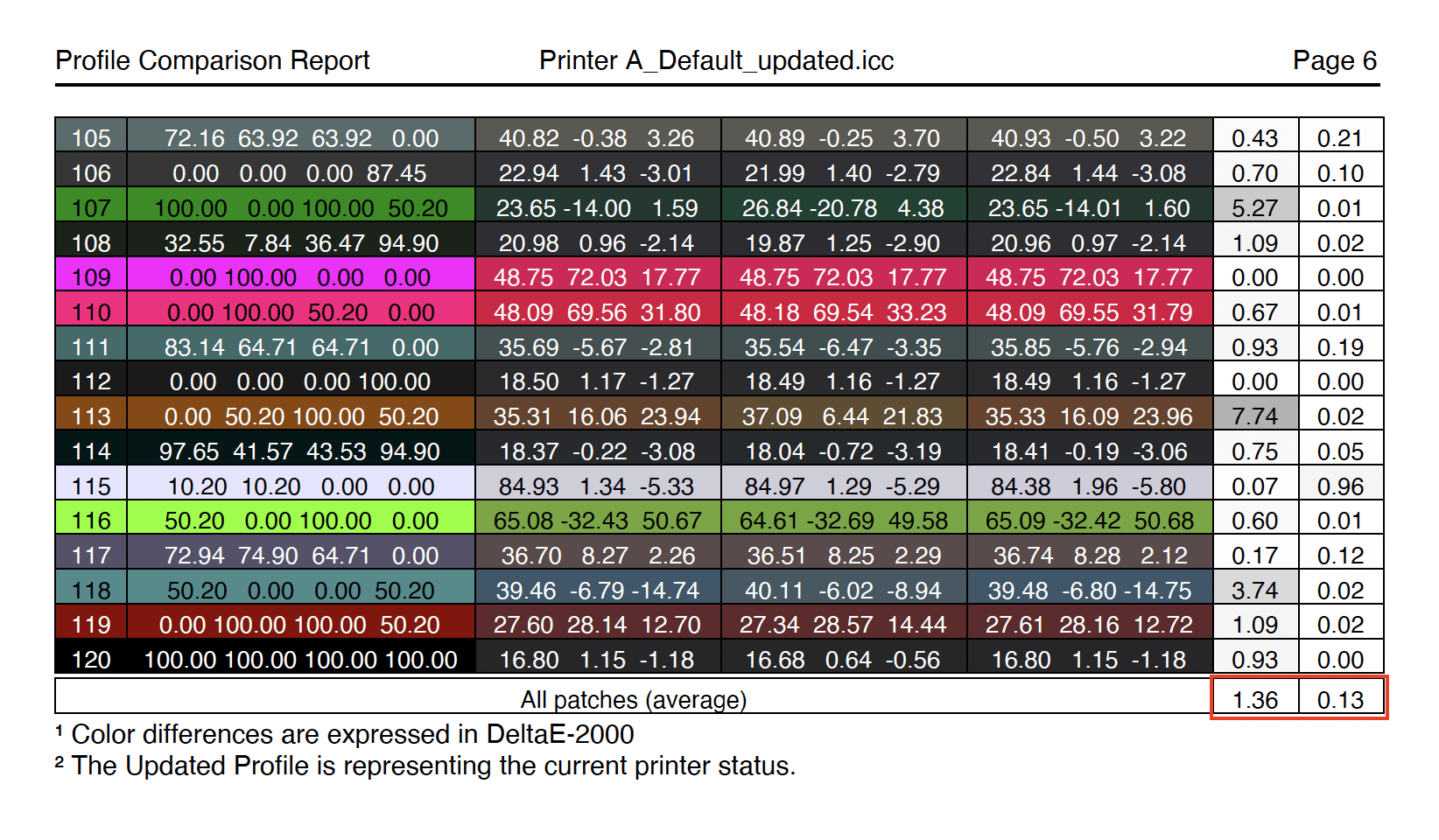
A Correction DeviceLink Profile can be created for the updated printer profile at the same time. It allows the adjustment of the print data to compensate for color deviations and achieve a color reproduction that accurately reflects the reference profile before the color changes. Using a Correction DeviceLink Profile ensures a consistent color reproduction.
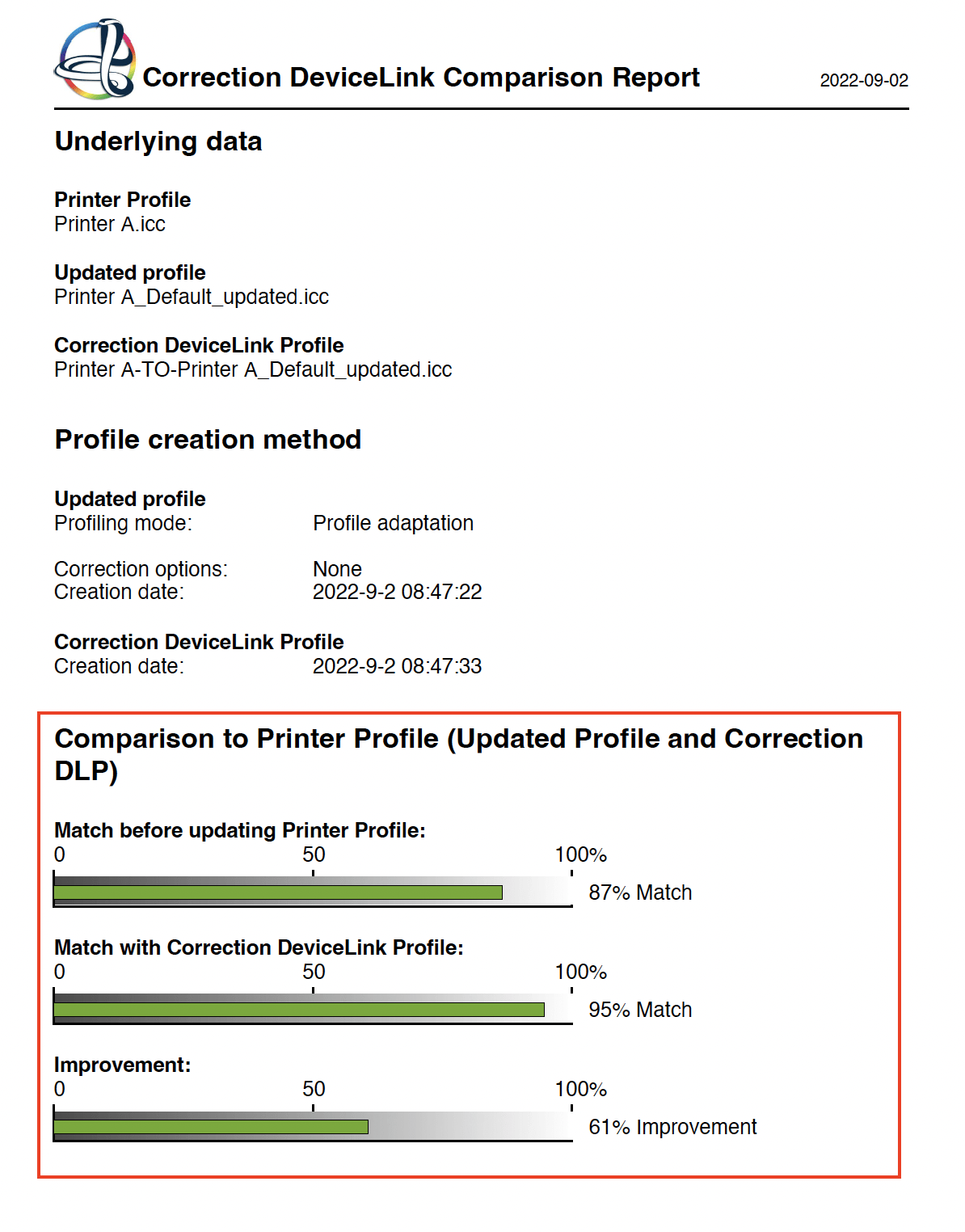
A Correction DeviceLink Comparison Report can be created in addition to the profile.
In the Comparison to Printer Profile (Updated Profile and Correction DLP) section of the comparison report, the Match score shows the quality of the Correction DeviceLink Profile to reproduce previous jobs with the new Correction DLP as well as possible.
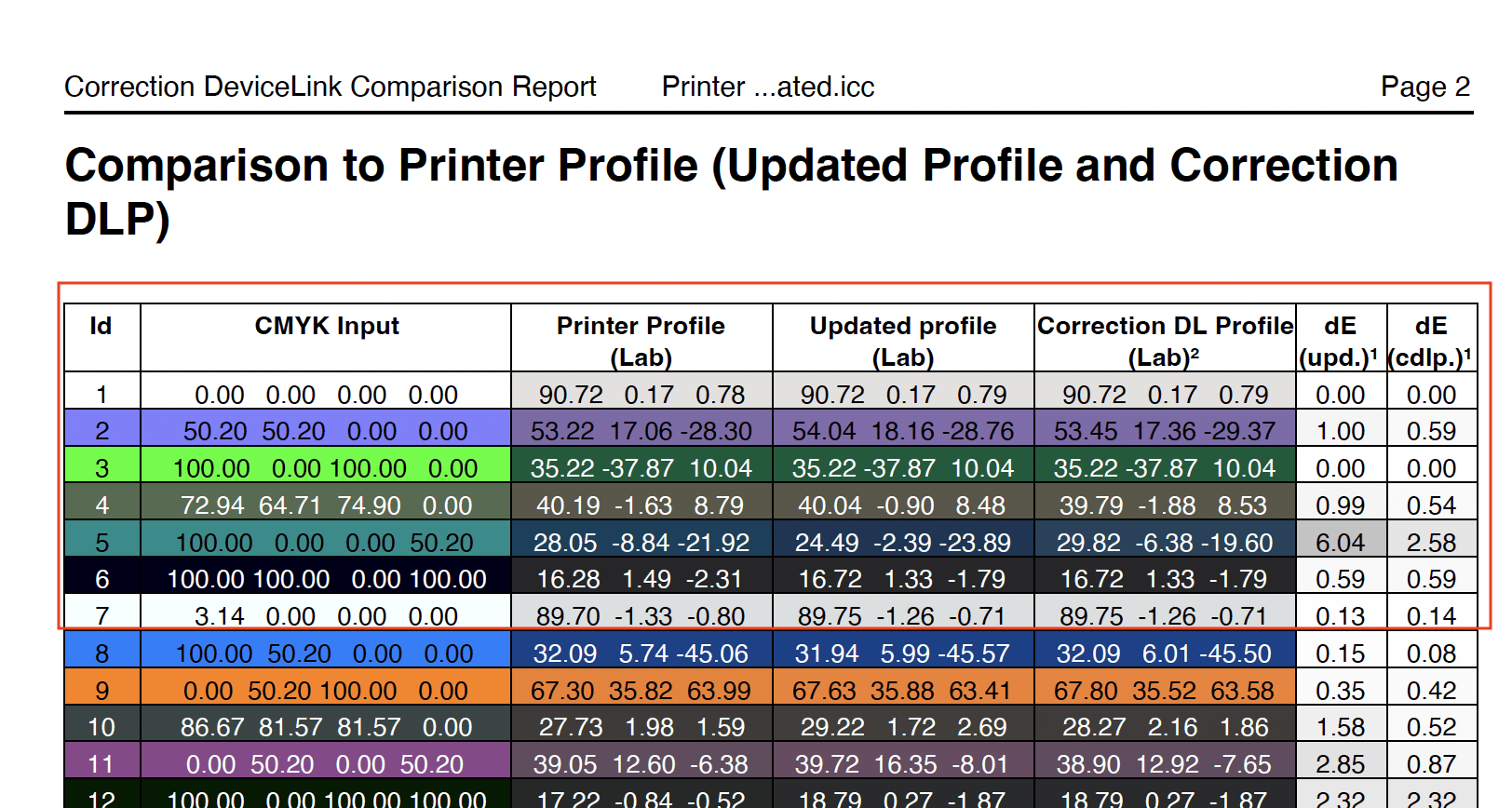
In addition, a detailed view of the measurement data is listed with an overall DeltaE evaluation comparing the Printer Profile with the Correction DeviceLink Profile.
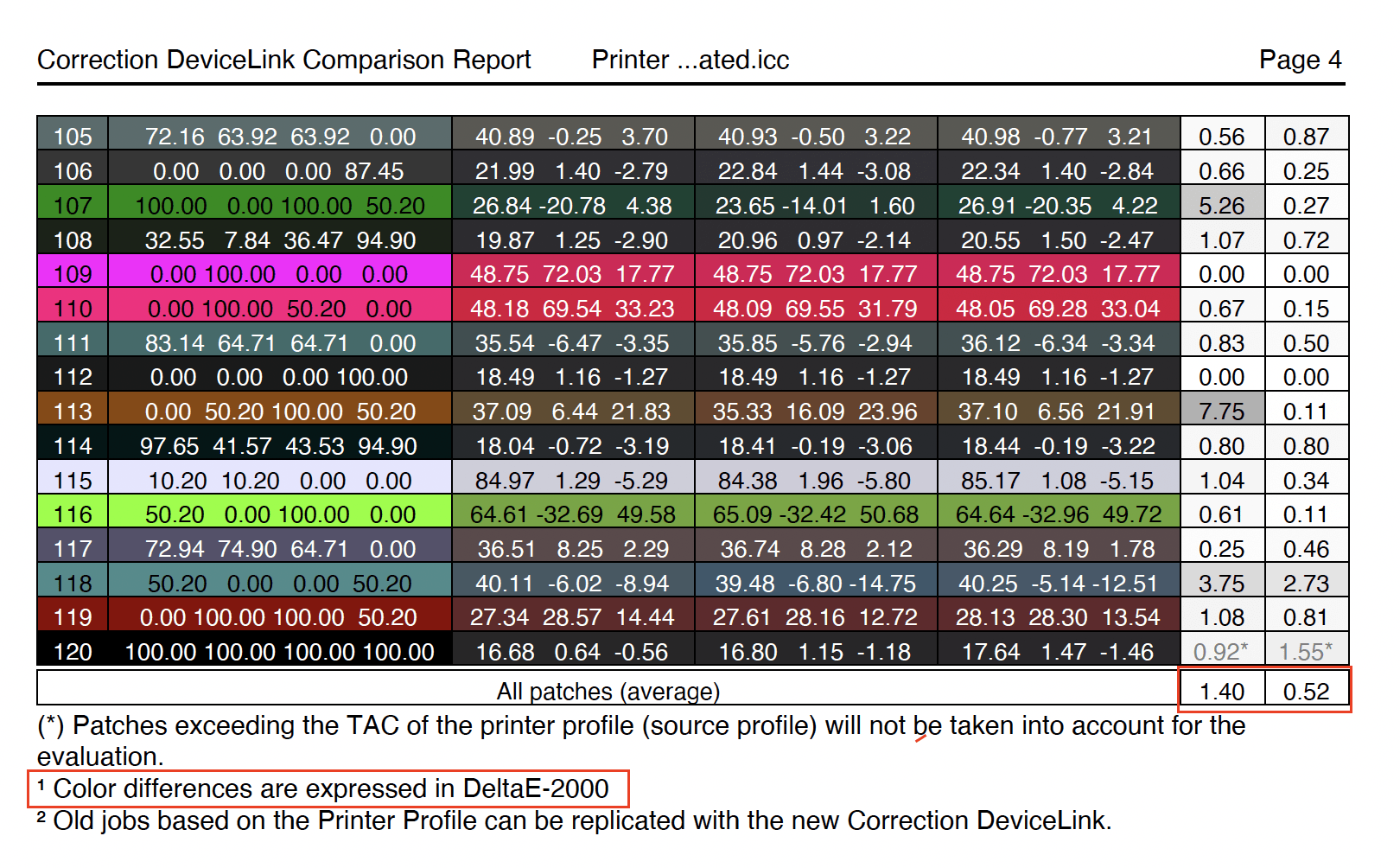
Printer Profiling
Calculate Multicolor Profile Variants
Multicolor profile variants, e.g. of a 7C output profile, are useful for determining whether fewer than 7 colors, e.g. 5 or 6 colors or even the CMYK colors alone are sufficient for printing a given job. After all, it is not always necessary to use 7 process colors and, especially in digital printing, costs can be saved by using fewer channels. By using the Multicolor profile variants, which use fewer process colors but the same separation settings as the original 7C profile, production costs can be reduced.
The new option “Calculate Multicolor Profile Variants” creates various combinations of the initial Multicolor profile. You can either automatically create different variants like 3CLR, 4CLR as well as CMYK+ at the same time or select them individually.
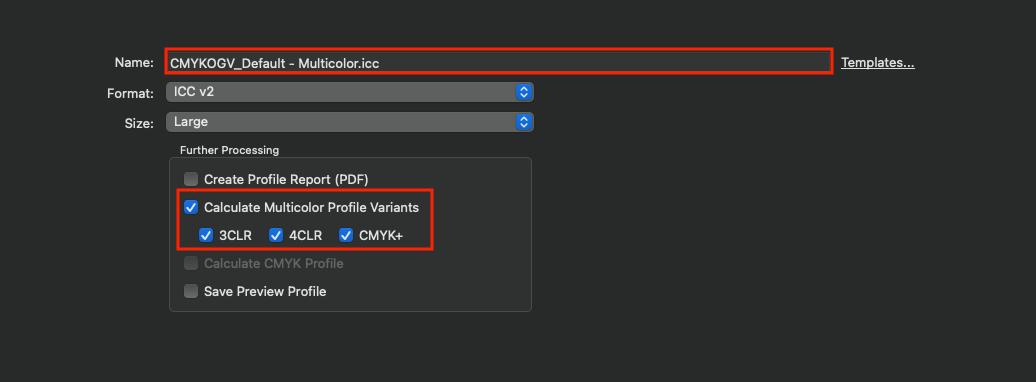
However, it is still possible to calculate a pure CMYK profile that uses only the CMYK part of the Multicolor data.
Note: The PDF report is created only for the initial Multicolor profile – not for the Multicolor profile variants. A profile report for a Multicolor profile variant can be created in the Profile Manager. Select the desired profile variant, right-click and select Create Profile Report (PDF) or (XML) from the context menu.
Improved reactivation of the Black channel
When reactivating the Black channel in Used Channels in the Printer Profiling/Color Generation tab, the Max. Black value under Black Point and TAC is now set to 100% and does not remain at 0% anymore.
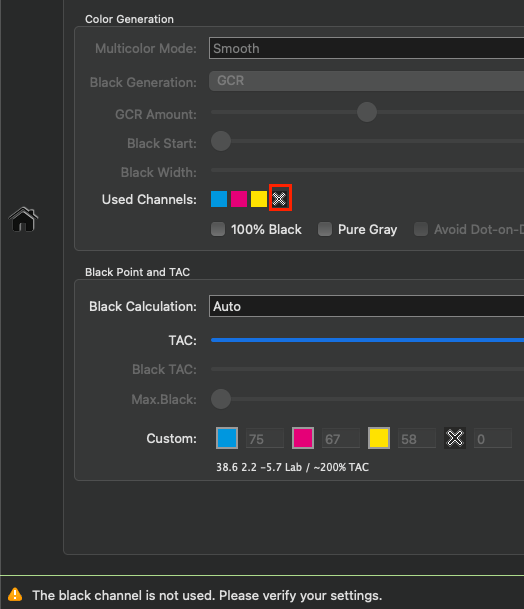
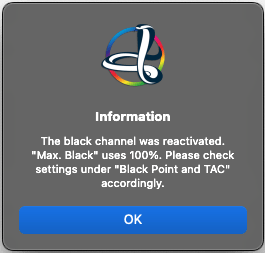
Improved preview of reference data when using White Ink
The preview of the reference data of a profiling chart with White ink shows the correct color of the White point. This even allows for a visual comparison of the reference and the measured data.
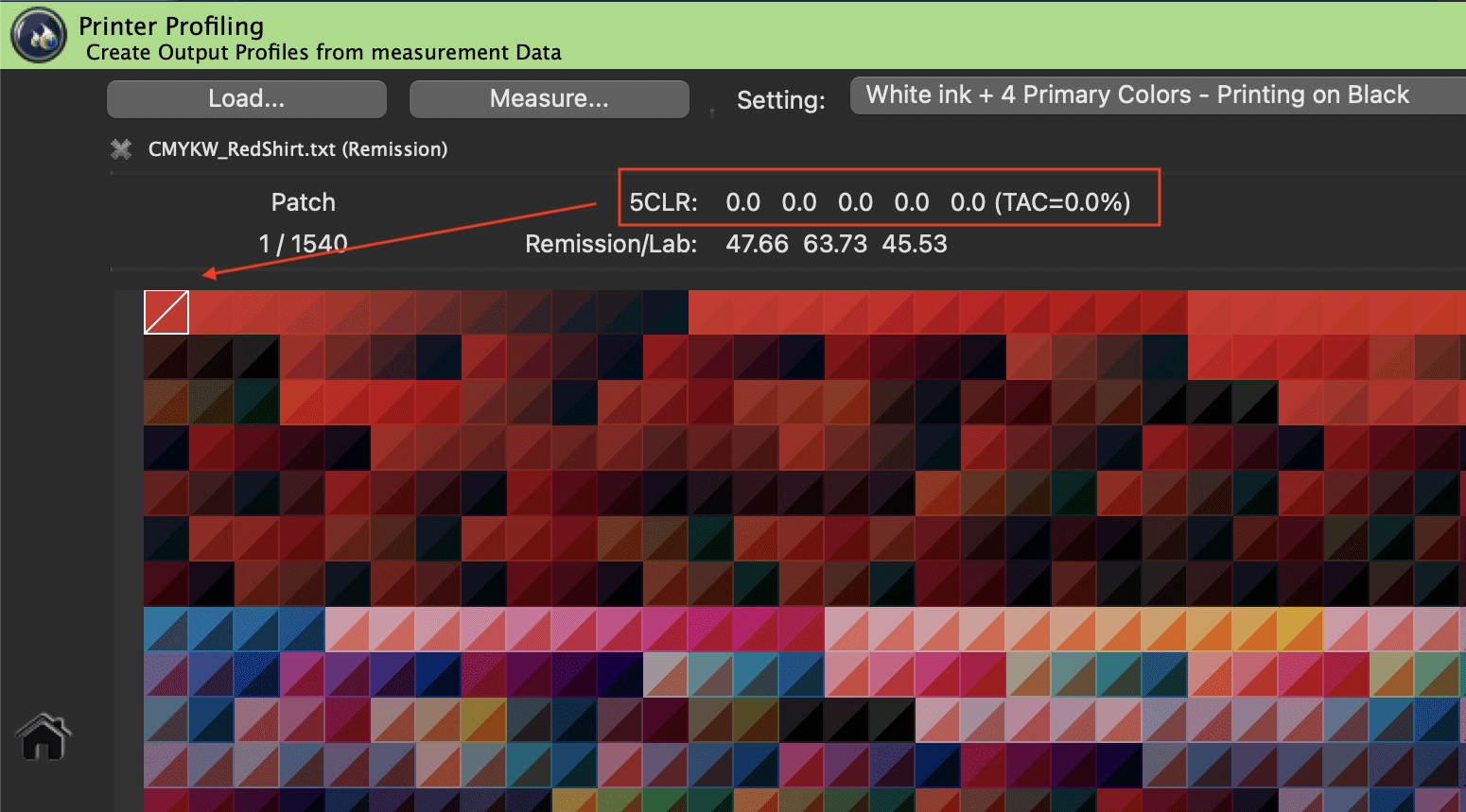
Data of red substrate such as a red shirt
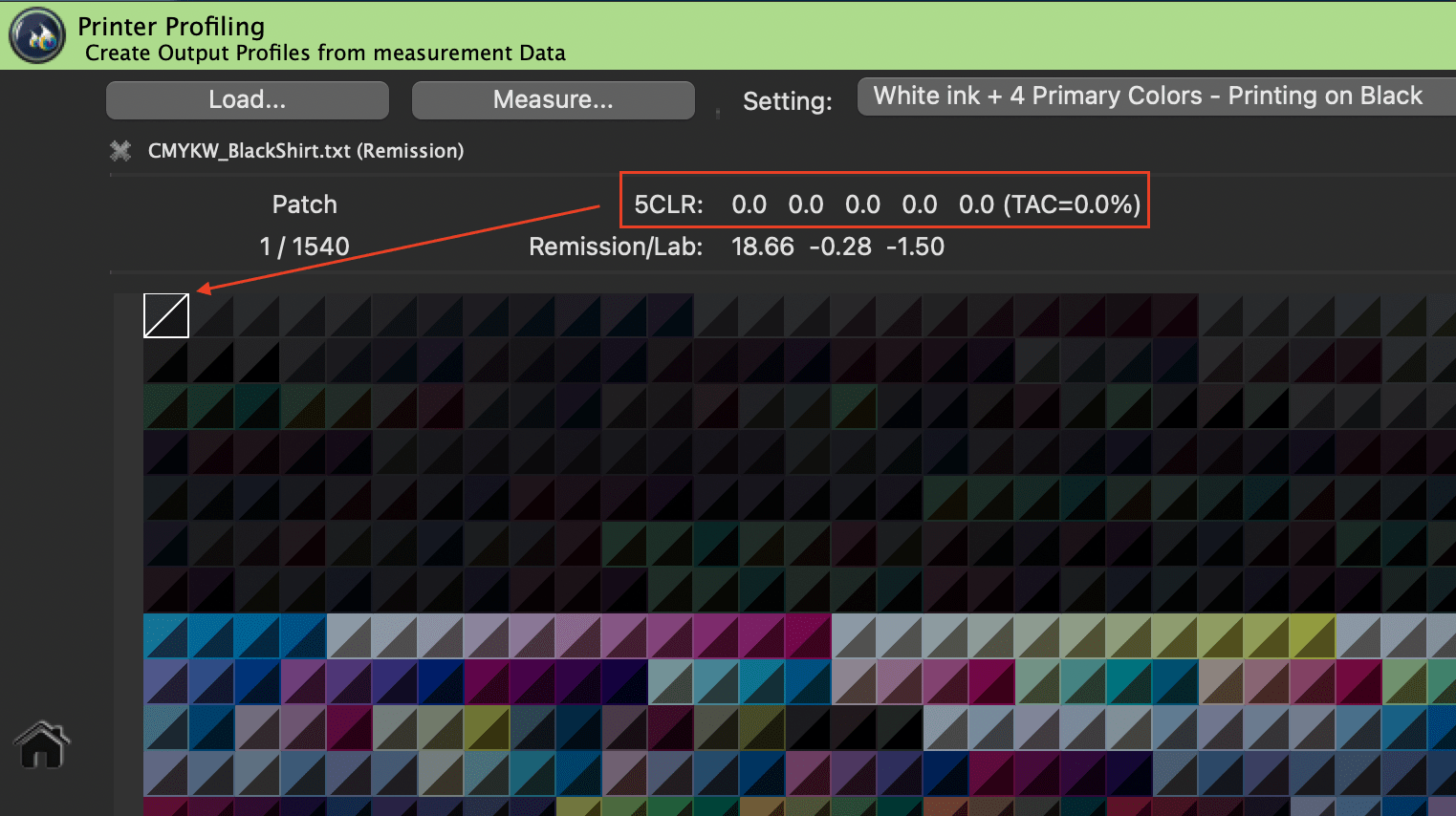
Data of black substrate such as a black shirt
Profile Manager
Gamut preview for DeviceLink profiles in the Profile Manager
The Profile Manager now also displays the gamut preview for DeviceLink profiles, regardless of the color spaces of the source and target profiles (e.g. RGB-2-RGB, CMYK-2-xCLR, RGB-2-xCLR).
Note: The gamut of DeviceLink profiles can only be displayed if the source and target profiles are found on the system.
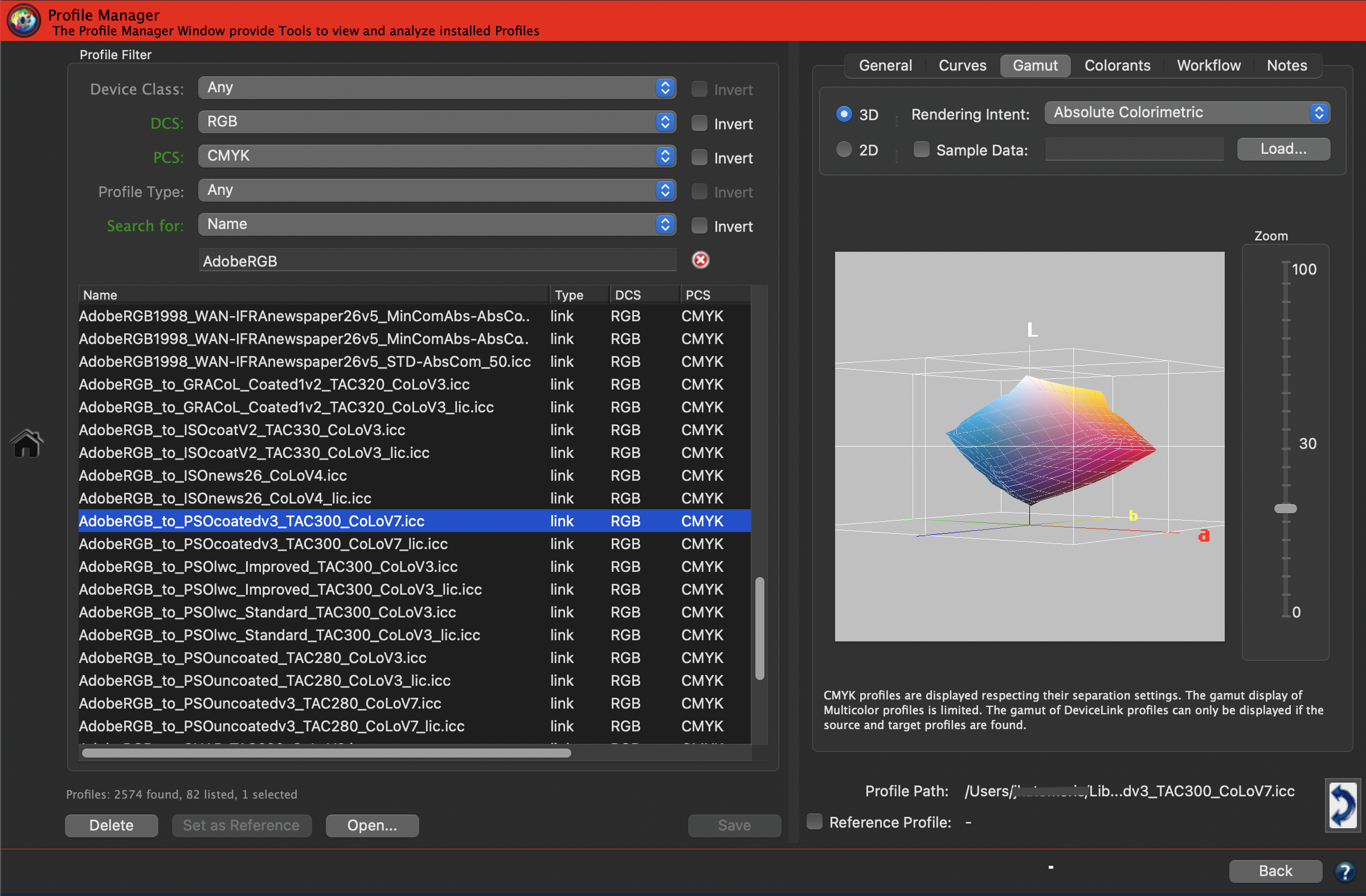
New 3D Gamut view scaling method
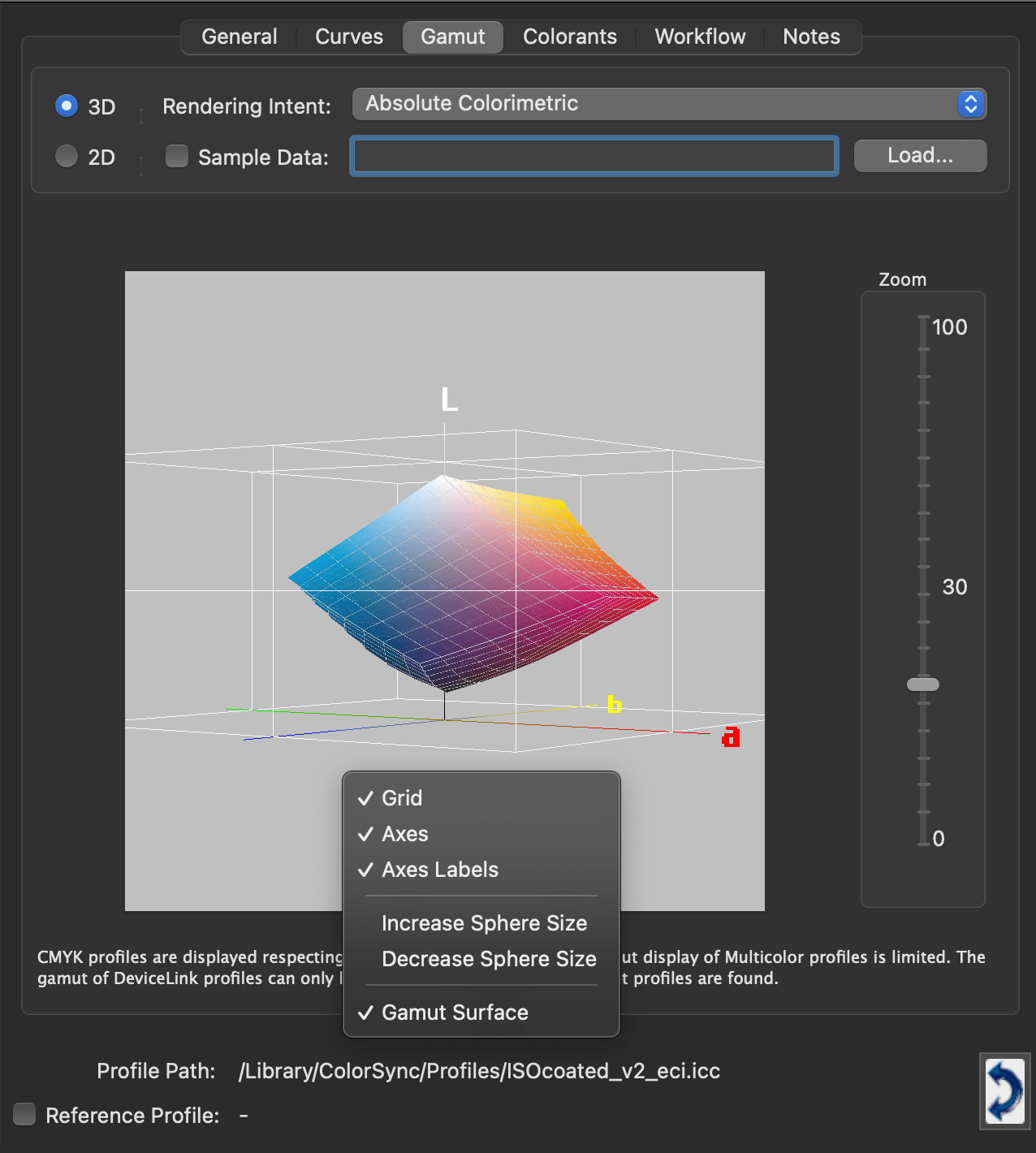
The new default 3D gamut view method is based on a different axes ratio of the Lab axes. The ratio of the axes to each other is now equal – Lab = 1:1:1. This is clearly noticeable in the preview.
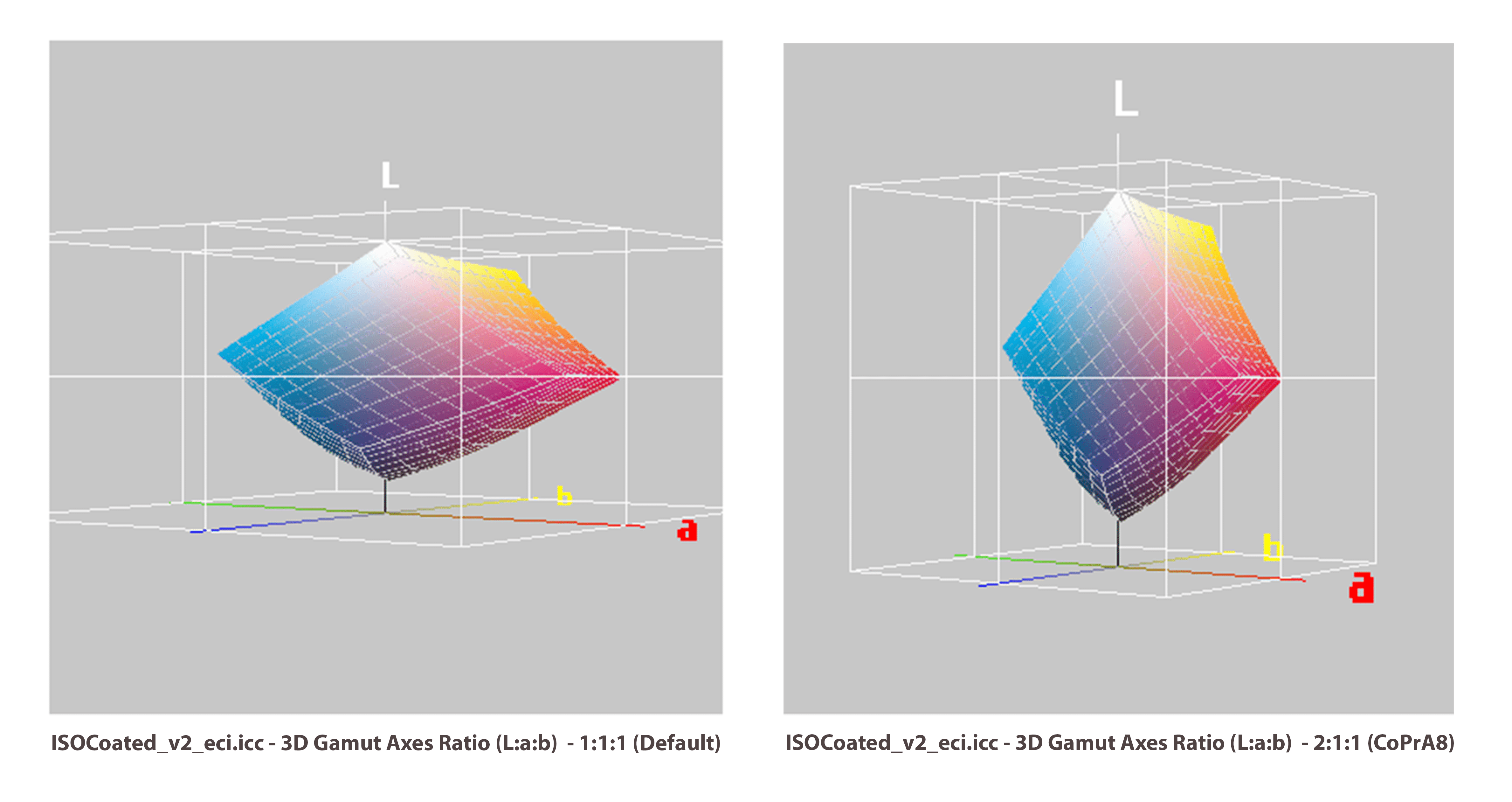
It is still possible to use the old axes ratio method (used in CoPrA 8 or older) by selecting the 2:1:1 option.
The view can be changed in the Preferences of CoPrA 9 by selecting the preferred 3D Gamut Axes Ratio (L:a:b) under Profile Manager options.

Please note that the 3D gamut view options also affect the gamut view in the Printer Profiling tool on the Color Generation tab.
New context menu offers several more gamut view options
A context menu with more view options can be opened with a right-click on the gamut view. From there you can switch the Grid, Axes and Axes Labels on and off. When analyzing Sample Data, the sphere size can be increased or decreased. For a better representation of the Sample Data, the gamut view can be switched between a Gamut Surface view and a polygonal gamut grid view.
Calculation of the profile gamut size in Gamut Comparison without Reference profile
The gamut Lab Volumes can now be calculated in the Gamut Comparison even without a Reference profile, allowing for a quick check of the gamut size for selected profiles (Sample).
DeviceLink/Printer Profiling
Improved perceptual rendering “Absolute Compression” for colorful substrates or substrates with high OBAs
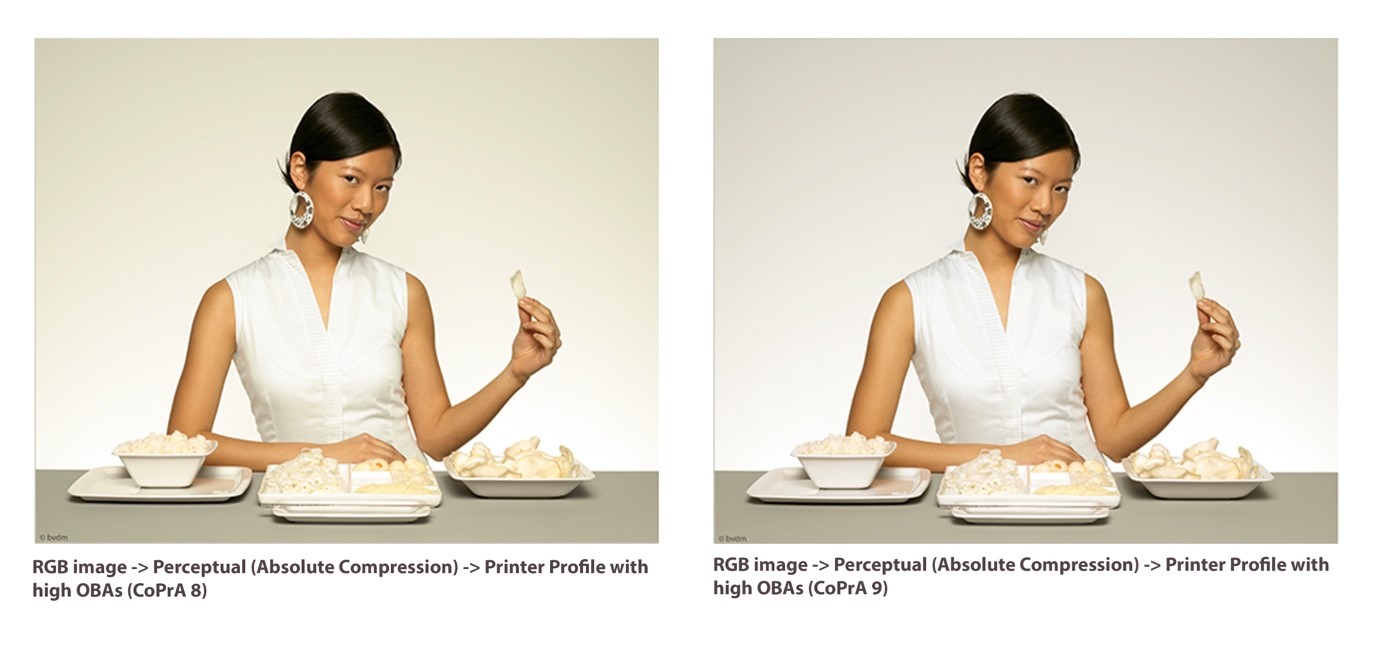
The perceptual rendering method Absolute Compression has been optimized when using colorful substrates or substrates with high OBAs.
The transition from the media white point to a neutral gray color has been significantly improved.
DeviceLink Linearization
New InkSplitting Calculation Mode in the Linearization tool combines light and full ink channels
The new Ink Splitting mode allows you to create ink splitting linearizations, automatically combining light and full ink channels. This minimizes the channels used in subsequent profiling.
Currently, only the combination of light and full color channels is supported (not e.g., the light light gray –> light gray –> full ink-splitting).
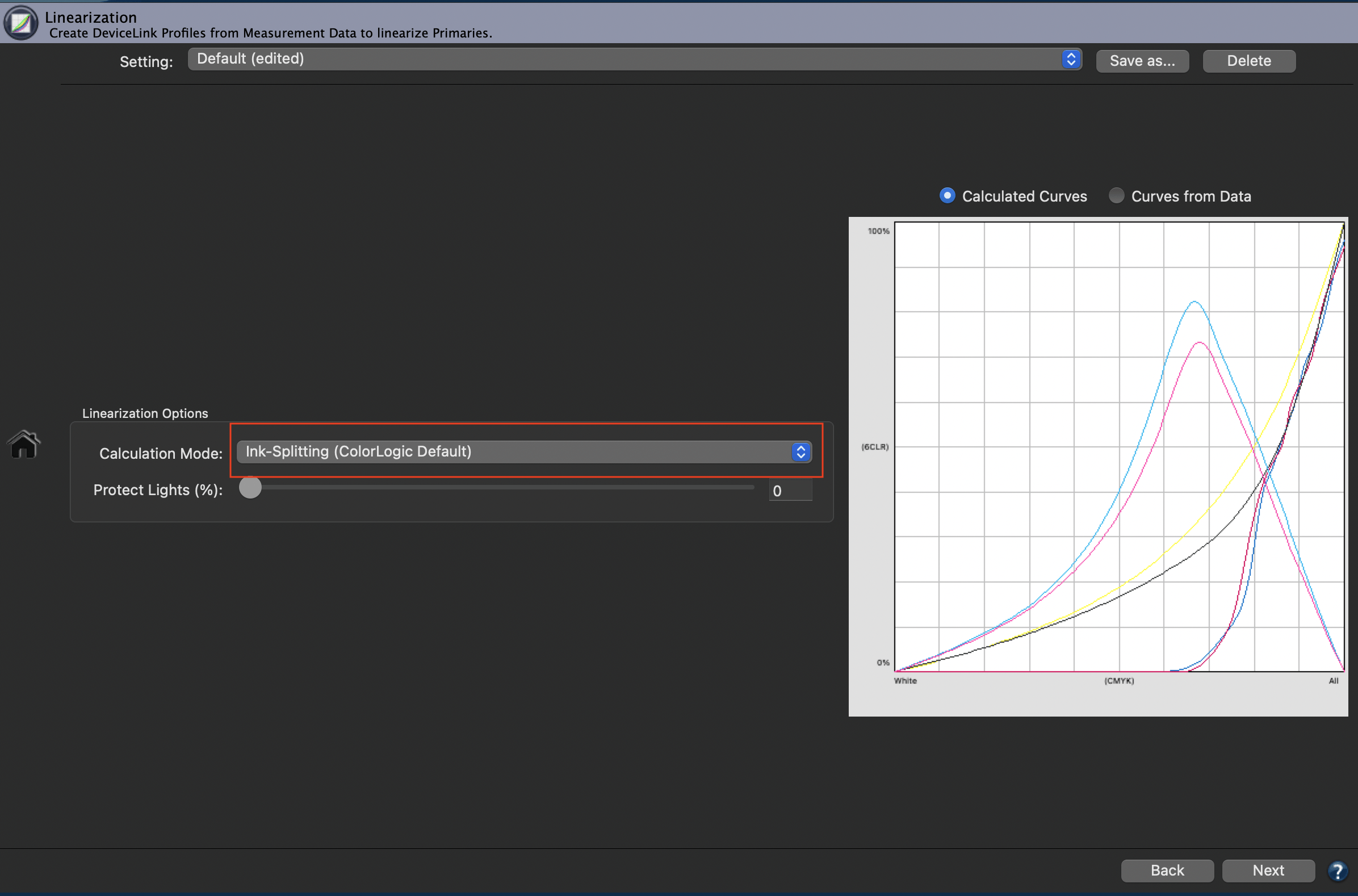
Note: InkSplitting linearization curves are included in the Linearization Profile Report and can be analyzed in more detail there.
Improved preview of reference data when using White Ink
Previews of the reference data of linearization charts with White ink now also show the correct color of the White point. This allows for a visual comparison of the reference and the measured data.
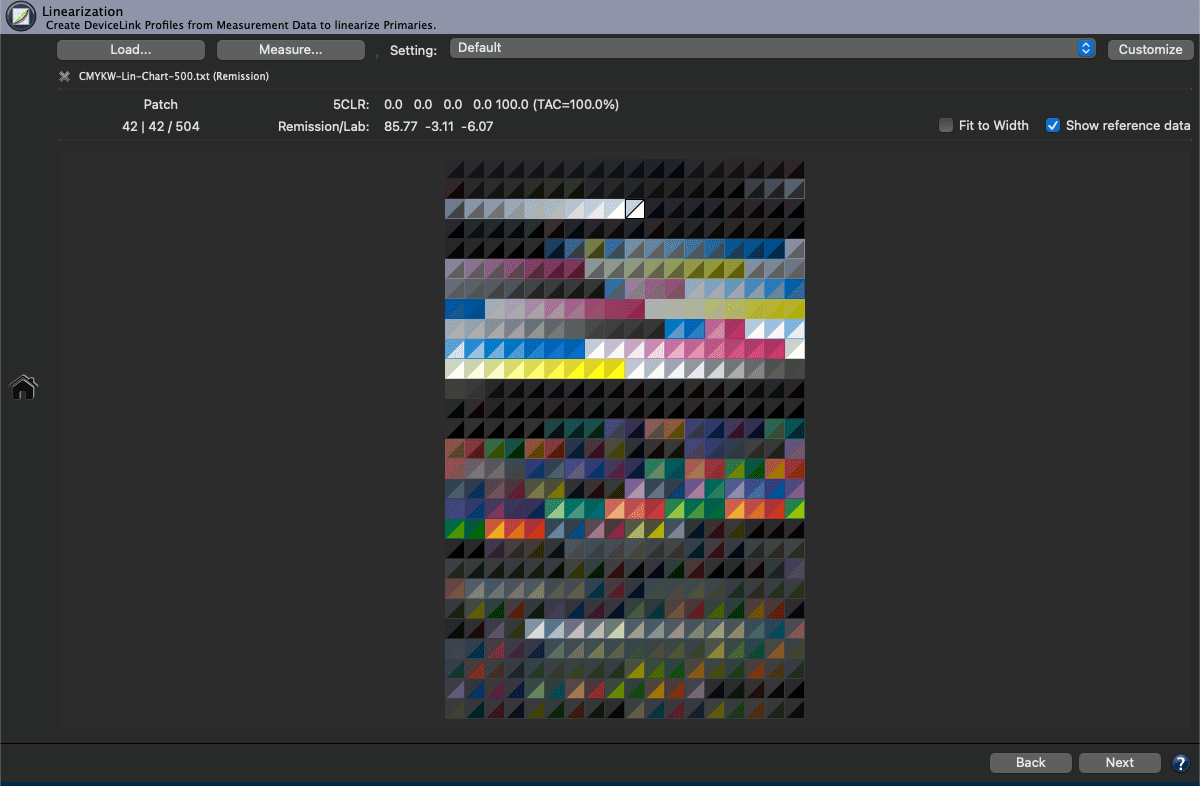
Image Conversion
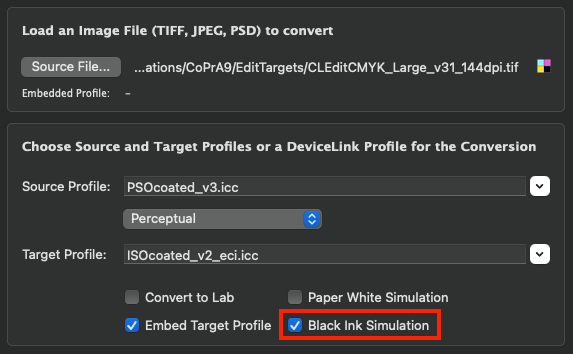
New softproof option “Black Ink Simulation”
The Black Ink Simulation can be used as a softproof in the preview for the defined color management workflow. The complete profile settings and rendering intents will be simulated on the screen under Target, simulating the Black Ink (relative colorimetric rendering intent).
In addition, when the Convert to Lab checkbox is enabled, the Black Ink Simulation checkbox can also be activated. If activated, the conversion to Lab uses the relative colorimetric rendering intent.
If both simulations (Paper White Simulation and Black Ink Simulation) are disabled, the rendering intent Relative Colorimetric with Black Point Compensation is used.
InkSave value now shown when using the “Use Layer” mode
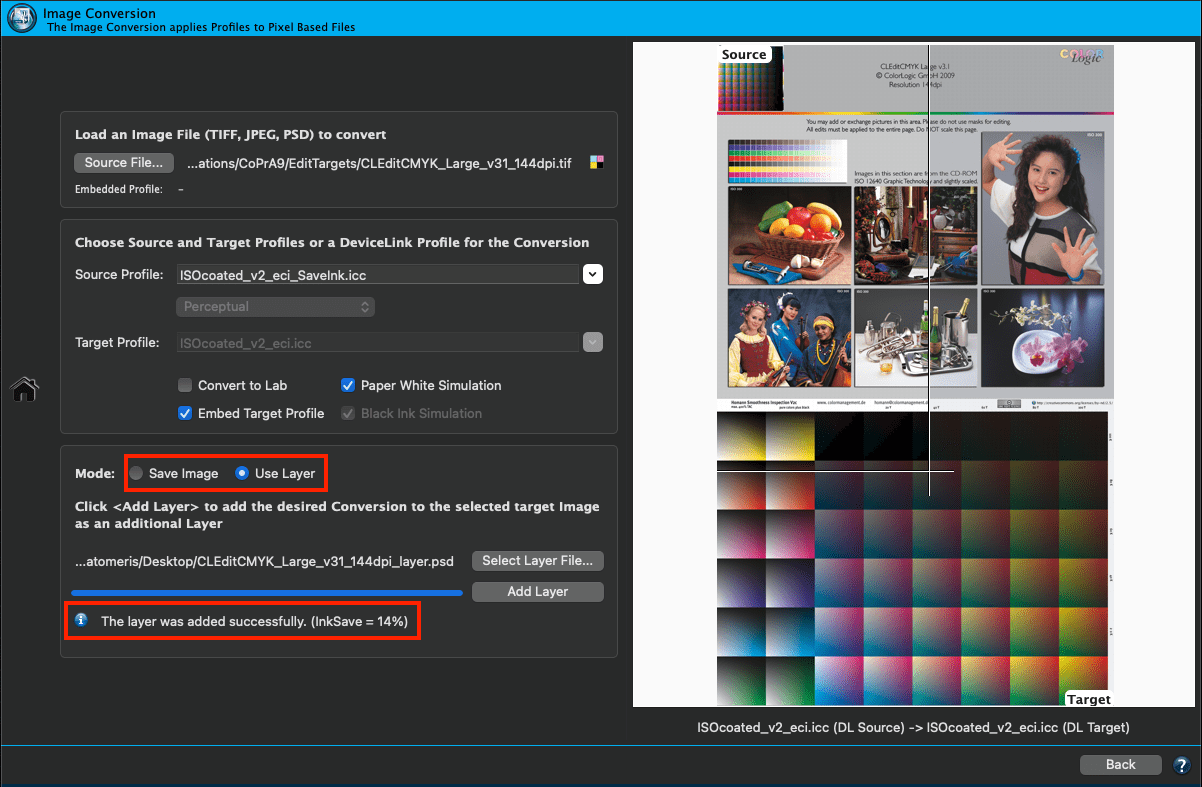
When using a DeviceLink SaveInk Profile and the Use Layer mode to add layers to a converted image in PSD file format, it is now possible to show the InkSave value after adding the layer into the PSD file. This allows the creation of a multi-layer file using different SaveInk profiles and a comparison in Photoshop.
The saving for each profile is shown as information in the bottom section of the Image Conversion.
macOS Support
Profile calculation speed boost due to native Apple M1 chip support
CoPrA 9 now runs natively on Apple computers using the Apple Silicon M1 chip. As a result, the profile calculation time for printer and DeviceLink profiling has been significantly improved.
On average, CoPrA 9 with native M1 chip support is up to 40% faster than CoPrA 8.
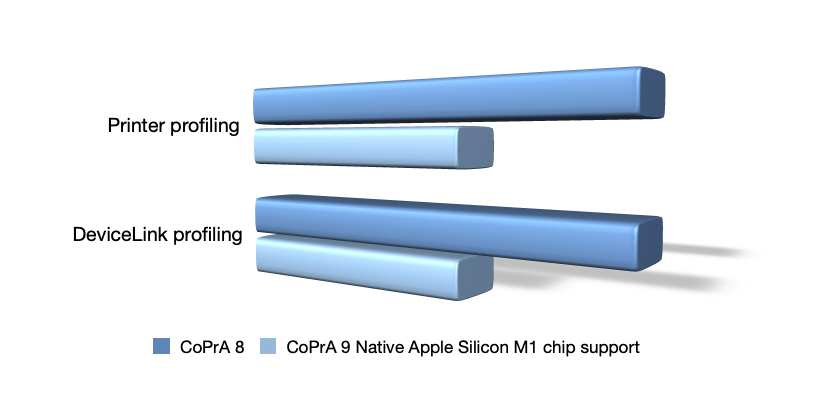
Table: Comparison of profiling calculation times tested on Apple MacBook Pro (13-inch, M1, 2020) with macOS 12.4
macOS support for Catalina (10.15.x), BigSur (11.x), Monterey (12.x) and Dark Mode
CoPrA 9 fully supports macOS Catalina, Big Sur, Monterey as well as the dark mode.
Improvements and bug fixes
General
- Messages in the profiling tools have been improved.
DeviceLink Iterate
- The DeviceLink Iteration now considers the TAC of the destination profile in the iterated DLP.
DeviceLink Editing
- Using a duotone image with spot color whose information refers to external, inaccessible data creates a gray image preview in the workflow Create DeviceLink from Edited Image.